
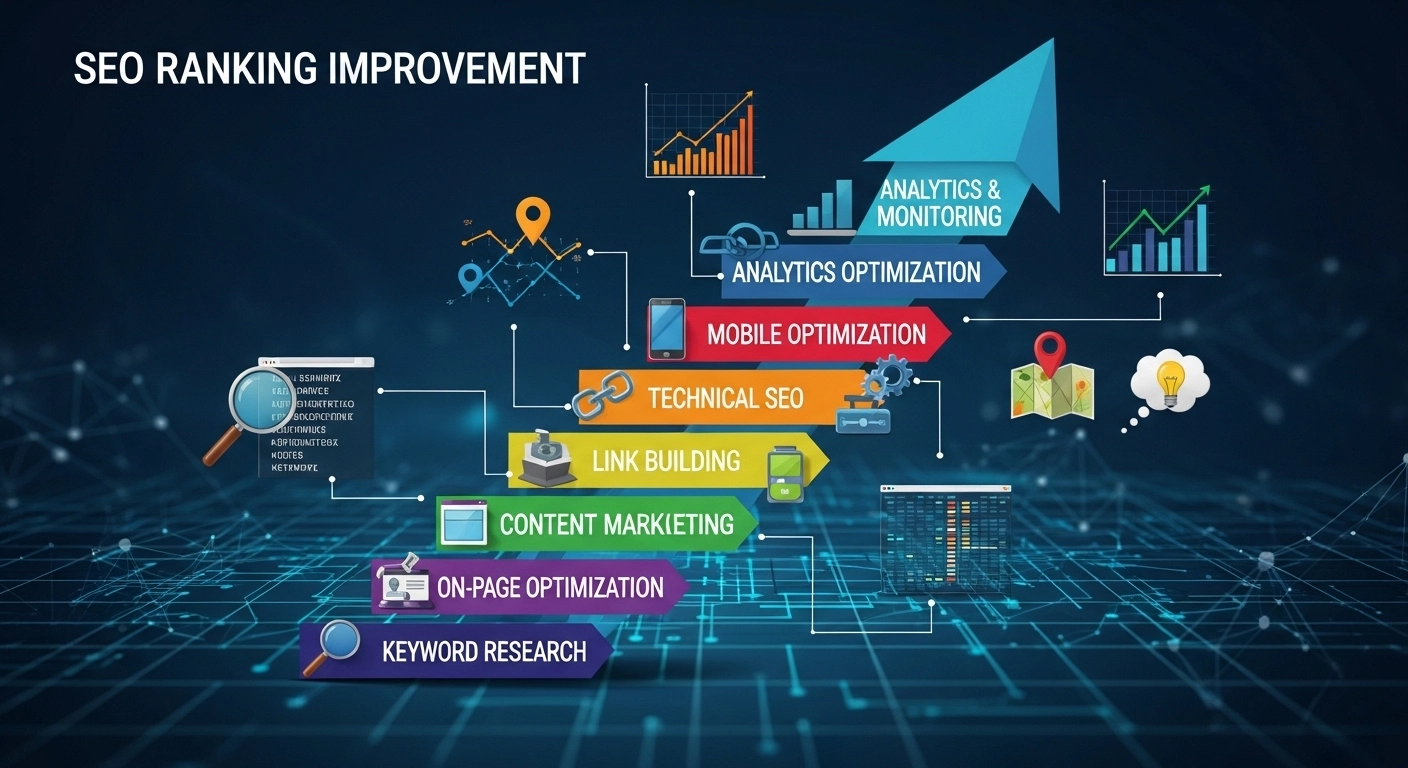
If your website isn’t getting the traffic you expect, the issue usually isn’t the product or service—it’s visibility. Ranking on Google is no longer about just adding keywords. It’s about building relevance, authority, and a smooth user experience.
In this guide, you’ll learn proven SEO ranking improvement techniques that actually help websites move up in search results—without shortcuts or outdated tricks.
1. Start With Search Intent (Not Just Keywords)
One of the biggest SEO mistakes is targeting keywords without understanding why people are searching.
Search intent usually falls into four types:
- Informational (learning something)
- Navigational (finding a specific site)
- Commercial (comparing options)
- Transactional (ready to buy)
Example:
If someone searches “best SEO tools,” they want comparisons—not a sales pitch.
How to improve rankings:
- Match your content format with intent (list, guide, review, tutorial)
- Analyze top-ranking pages before writing
- Answer the exact question users expect
When your content matches intent, Google rewards it with better visibility.
2. Improve On-Page SEO Structure
On-page SEO helps search engines understand your content clearly.
Key areas to optimize:
- Title tag (include your main keyword naturally)
- Meta description (clear, compelling, and relevant)
- Headings (H1, H2, H3 for structure)
- Internal links to related pages
- Image alt text
Example:
Instead of a vague heading like:
“Tips for SEO”
Use:
“Proven SEO Ranking Improvement Techniques for Higher Google Visibility”
Clear structure improves both rankings and readability.
3. Create High-Quality, Helpful Content
Google prioritizes content that solves real problems.
Ask yourself:
- Does this content fully answer the user’s question?
- Is it better than what’s already ranking?
What works best:
- Step-by-step guides
- Real-world examples
- Data-backed insights
- Clear explanations (not jargon-heavy writing)
Thin or generic content rarely ranks today. Depth matters more than length.
4. Focus on Technical SEO Health
Even great content can struggle if your website has technical issues.
Check these important factors:
- Page speed (slow sites lose rankings)
- Mobile responsiveness
- Crawl errors and broken links
- Proper indexing in Google Search Console
- Clean URL structure
Simple example:
A page that takes 6 seconds to load will often rank lower than a faster competitor—even with better content.
Technical SEO ensures Google can easily access and understand your site.
5. Build Strong Internal Linking
Internal links help distribute authority across your website.
Why it matters:
- Helps Google discover new pages
- Improves site structure
- Keeps users on your site longer
Example:
If you write about SEO tools, link it to:
- SEO keyword research guides
- Technical SEO articles
- Ranking strategy posts
Think of internal links as pathways guiding both users and search engines.
6. Earn High-Quality Backlinks
Backlinks are still one of the strongest ranking signals.
But quality matters more than quantity.
Good backlink sources:
- Industry blogs
- News websites
- Guest posts on relevant sites
- Resource pages
Avoid:
- Spammy directories
- Low-quality link farms
- Irrelevant websites
A single strong backlink can outperform dozens of weak ones.
7. Optimize for User Experience (UX)
Google measures how users interact with your site.
If people leave quickly, rankings drop.
Improve UX by:
- Using clean, readable fonts
- Breaking content into short paragraphs
- Adding bullet points and visuals
- Reducing pop-ups and distractions
Key metric:
Dwell time (how long users stay on your page)
Better experience = stronger rankings over time.
8. Update and Refresh Old Content
Old content can lose rankings even if it once performed well.
How to refresh:
- Update outdated information
- Add new keywords naturally
- Improve headings and structure
- Insert new internal links
- Expand weak sections
Example:
A blog post from 2023 about SEO tools should be updated with 2026 tools and trends.
Fresh content signals relevance to Google.
9. Use Semantic SEO (Related Keywords)
Modern SEO is not about repeating one keyword—it’s about covering the topic fully.
Instead of focusing only on:
“SEO ranking improvement techniques”
Also include related terms like:
- search engine optimization strategies
- Google ranking factors
- organic traffic growth
- website authority
- content optimization
This helps Google understand your topic depth.
10. Track Performance and Improve Continuously
SEO is not a one-time task.
Monitor:
- Keyword rankings
- Organic traffic
- Bounce rate
- Click-through rate (CTR)
Tools you can use:
- Google Search Console
- Google Analytics
- SEO tracking tools
Then refine your strategy based on real data.
FAQ: SEO Ranking Improvement Techniques
1. How long does SEO take to improve rankings?
Usually 3–6 months, depending on competition, content quality, and backlinks.
2. What is the fastest way to improve SEO ranking?
Improving page speed, fixing on-page SEO issues, and updating content can show quicker results.
3. Do backlinks still matter in 2026?
Yes, but quality backlinks from trusted websites matter far more than quantity.
4. Can I rank without backlinks?
Yes, for low-competition keywords—but backlinks are still important for competitive topics.
5. What is the most important SEO factor?
High-quality content that matches search intent remains the most important factor.
Conclusion
Improving your SEO rankings isn’t about shortcuts—it’s about consistency and smart optimization. When you combine strong content, technical health, user experience, and authority building, rankings naturally improve over time.
Focus on solving real user problems, and Google will reward your effort with better visibility.
