
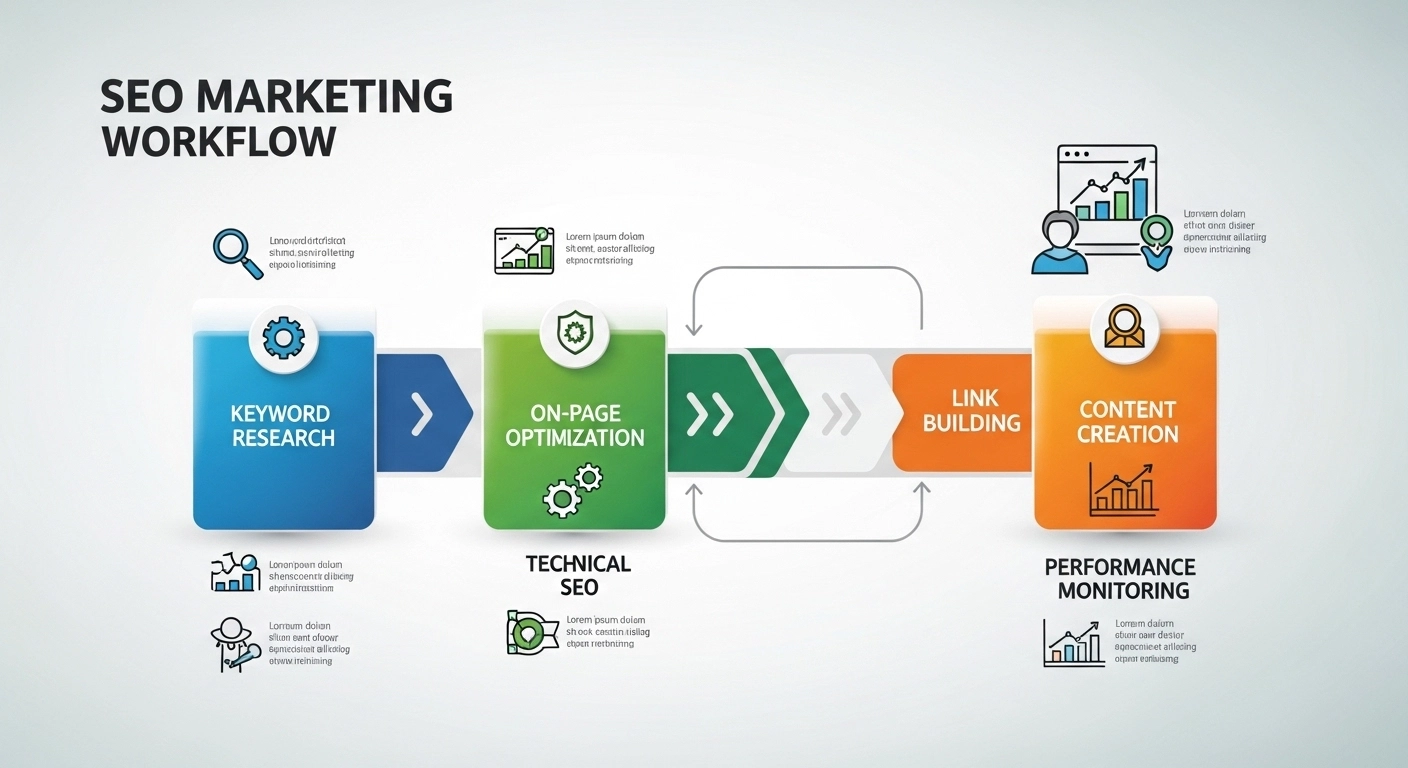
A strong SEO marketing workflow is what separates random content efforts from a structured system that consistently brings traffic, leads, and revenue. Without a clear workflow, SEO becomes guesswork—keywords are targeted randomly, content is published inconsistently, and technical issues go unnoticed.
In this guide, you’ll learn a complete, real-world SEO marketing workflow that professionals use to plan, create, optimize, and scale search visibility.
What Is an SEO Marketing Workflow?
An SEO marketing workflow is a structured process that guides how SEO tasks are planned, executed, and measured.
It connects every stage of SEO, including:
- Keyword research
- Content planning
- On-page optimization
- Technical SEO
- Link building
- Performance tracking
Instead of treating SEO as separate tasks, a workflow turns it into a repeatable system.
Step 1: Keyword Research and Search Intent Mapping
Everything starts with understanding what people are searching for.
A strong SEO workflow focuses on search intent, not just keywords.
Break keywords into:
- Informational (e.g., “what is SEO marketing workflow”)
- Commercial (e.g., “best SEO tools”)
- Transactional (e.g., “SEO services pricing”)
Practical Example:
If you run a marketing blog, instead of targeting only “SEO workflow,” you expand into:
- SEO content planning process
- SEO strategy workflow for beginners
- How to build an SEO system
This creates topic depth and improves topical authority.
Step 2: Content Planning and Topic Clustering
Once keywords are ready, organize them into clusters.
A modern SEO workflow uses a pillar and cluster model:
- Pillar page: Main topic (SEO marketing workflow)
- Cluster content: Supporting articles (tools, strategies, audits, etc.)
Example Structure:
- Pillar: SEO Marketing Workflow Guide
- Cluster 1: Keyword Research Process
- Cluster 2: On-Page SEO Checklist
- Cluster 3: Technical SEO Audit Steps
- Cluster 4: Content Optimization Strategy
This helps search engines understand your authority on the topic.
Step 3: SEO Content Creation Process
Now comes content production.
A high-performing SEO workflow includes:
1. Outline First
Before writing, create a structured outline with headings and subtopics.
2. Write for Humans First
Focus on clarity, not keyword density. Use natural language and helpful explanations.
3. Add Semantic Keywords
Include related terms like:
- SEO strategy
- organic traffic
- search rankings
- content optimization
- Google algorithm
4. Improve Readability
- Short paragraphs
- Clear headings
- Simple language
- Real examples
Step 4: On-Page SEO Optimization
After writing, optimize every page properly.
Key on-page SEO elements include:
- Title tag optimization
- Meta description writing
- Proper heading structure (H1, H2, H3)
- Internal linking
- Image alt text
- URL structure
Practical Tip:
Your main keyword should appear naturally in:
- Title
- First paragraph
- One or two subheadings
But avoid forcing it everywhere.
Step 5: Technical SEO Checks
Even great content won’t rank if your website has technical issues.
Your SEO marketing workflow should include regular checks for:
- Page speed performance
- Mobile responsiveness
- Crawl errors
- Broken links
- Indexing issues
- XML sitemap health
Tools like Google Search Console and PageSpeed Insights are commonly used here.
Step 6: Internal Linking Strategy
Internal links guide both users and search engines.
A strong workflow ensures:
- New content links to old content
- Old content links to new content
- Pillar pages receive the most internal links
Example:
A blog about “SEO content creation” should link back to your main “SEO marketing workflow” page.
This builds authority and improves ranking potential.
Step 7: Off-Page SEO and Link Building
Backlinks remain a major ranking factor.
Your workflow should include:
- Guest posting
- Outreach campaigns
- Digital PR
- Content promotion
- Directory submissions (quality ones only)
Focus on quality, not quantity. A few strong backlinks beat hundreds of weak ones.
Step 8: Performance Tracking and Optimization
SEO is not a one-time task. It’s continuous improvement.
Track:
- Organic traffic growth
- Keyword rankings
- Click-through rate (CTR)
- Bounce rate
- Conversions
Tools commonly used:
- Google Analytics
- Google Search Console
Then refine your content based on performance data.
Simple SEO Marketing Workflow Summary
Here’s the full system in order:
- Keyword research
- Intent mapping
- Content planning (clusters)
- Content creation
- On-page SEO
- Technical SEO
- Internal linking
- Link building
- Performance tracking
Repeat this cycle consistently.
FAQ: SEO Marketing Workflow
1. Why is an SEO marketing workflow important?
It creates structure, improves efficiency, and helps you scale SEO results consistently instead of guessing.
2. How long does SEO take to show results?
Usually 3–6 months, depending on competition, content quality, and website authority.
3. Do I need tools for SEO workflow?
Yes. Tools like Google Search Console, Ahrefs, SEMrush, or Ubersuggest help streamline the process.
4. Is SEO a one-time process?
No. SEO is continuous and requires regular updates and optimization.
Conclusion
A well-defined SEO marketing workflow is the backbone of successful digital marketing. It connects research, content creation, optimization, and performance tracking into one system that drives consistent organic growth.
When you follow a structured workflow instead of random actions, your SEO becomes predictable, scalable, and far more effective.
