
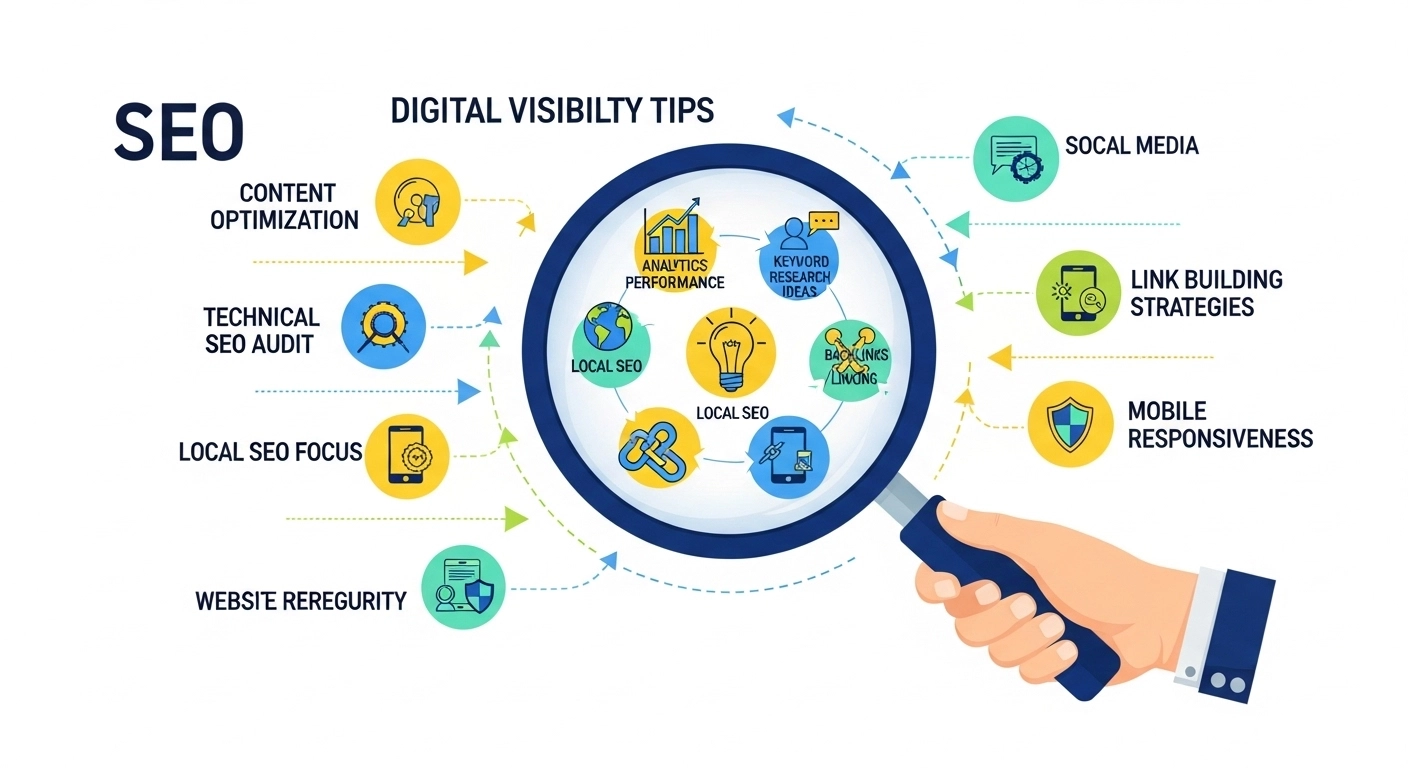
If your website isn’t getting traffic, the problem usually isn’t the content alone—it’s visibility. In today’s crowded search landscape, simply publishing pages isn’t enough. You need a smart approach to SEO that helps your brand actually show up where people are searching.
This guide breaks down practical, modern SEO digital visibility tips that help you improve rankings, attract qualified traffic, and stay competitive without relying on guesswork or outdated tactics.
What “Digital Visibility” Really Means in SEO
Digital visibility is how easily your website can be found across search engines, not just for one keyword—but for a whole topic or intent.
It includes:
- Ranking in Google search results
- Appearing in featured snippets or AI summaries
- Being visible for related long-tail keywords
- Getting indexed properly across your site
- Building topical authority in your niche
In simple terms: if people search for what you offer, can they find you?
1. Focus on Search Intent, Not Just Keywords
One of the biggest SEO mistakes is writing for keywords instead of intent.
Before creating content, ask:
- Is the user trying to learn something?
- Are they comparing options?
- Are they ready to buy or take action?
For example, someone searching “SEO digital visibility tips” likely wants:
- Practical strategies
- Clear explanations
- Actionable steps (not theory)
So your content should avoid fluff and focus on real solutions.
👉 Tip: Match headings and structure to what users actually expect to see.
2. Build Topic Clusters Instead of Random Pages
Google now rewards topical authority more than isolated articles.
Instead of writing one blog post and moving on, build clusters:
- A main “pillar” page (broad topic)
- Supporting articles (specific subtopics)
- Internal links connecting everything
Example cluster for SEO visibility:
- SEO digital visibility tips (pillar)
- On-page SEO checklist
- Keyword research strategy
- Internal linking guide
- Technical SEO basics
This structure tells search engines: “This site is an expert in this topic.”
3. Improve On-Page SEO Without Over-Optimizing
On-page SEO still matters—but it should feel natural.
Focus on:
- Clear title tags (include primary keyword once)
- Descriptive meta descriptions
- Proper H1, H2, H3 structure
- Short, readable paragraphs
- Internal links to related content
Avoid stuffing keywords into every sentence. Google understands context now, so natural writing performs better.
4. Strengthen Internal Linking for Better Crawlability
Internal links are one of the most underrated SEO visibility tools.
They help:
- Google discover your pages faster
- Pass authority between articles
- Keep users engaged longer
Best practice:
- Link related content naturally within paragraphs
- Use descriptive anchor text (not “click here”)
- Prioritize linking to your most important pages
Think of your website like a map—internal links guide both users and search engines.
5. Optimize for Featured Snippets and AI Results
Modern search is evolving. Google often shows direct answers at the top.
To increase your chances:
- Answer questions clearly in 40–60 words
- Use bullet points for steps or lists
- Add simple definitions under headings
- Structure content logically
Example:
Instead of a long explanation, write:
SEO visibility means how easily your website appears in search results for relevant queries. It depends on rankings, indexing, and topical authority.
Clear, direct answers win more visibility today than long paragraphs.
6. Improve Technical SEO (The Hidden Foundation)
Even great content won’t rank if your site has technical issues.
Key areas to check:
- Page speed (slow sites lose rankings)
- Mobile responsiveness
- Proper indexing in Google Search Console
- Clean URL structure
- No broken links or duplicate pages
Think of technical SEO as the foundation of a house. Without it, everything else becomes unstable.
7. Build Authority with High-Quality Content
Search engines prioritize trust and expertise.
To build authority:
- Publish in-depth, useful content regularly
- Avoid thin or repetitive articles
- Include real examples and insights
- Update older posts to keep them fresh
You don’t need to publish daily—you need to publish content that actually helps users.
8. Strengthen Your Brand Signals
Google also looks at brand trust signals like:
- Branded searches
- Mentions across the web
- Consistent business information
- User engagement (time on site, clicks)
Even small brands can improve this by:
- Sharing content on social platforms
- Building consistent messaging
- Getting listed on relevant directories
Stronger brand signals = stronger visibility over time.
9. Track What Actually Works
SEO without tracking is just guessing.
Monitor:
- Keyword rankings
- Organic traffic growth
- Click-through rates (CTR)
- Top-performing pages
Use this data to:
- Improve weak pages
- Expand high-performing topics
- Remove or update underperforming content
SEO visibility improves fastest when decisions are data-driven.
FAQ: SEO Digital Visibility Tips
1. How long does it take to improve SEO visibility?
Usually 3–6 months, depending on competition, content quality, and site authority.
2. Do keywords still matter in SEO?
Yes, but context matters more than exact keyword repetition.
3. What is the fastest way to improve visibility?
Fix technical SEO issues and improve internal linking first—they often give quick wins.
4. Can small websites compete with big brands?
Yes, by targeting long-tail keywords and building topical authority in a niche.
Conclusion
Improving digital visibility isn’t about one trick—it’s about building a complete SEO system. When you combine strong content, technical health, internal linking, and search intent alignment, your website naturally becomes easier to find and trust.
The key is consistency. Small improvements across multiple areas create long-term visibility gains.
