
If your website is not ranking on Google, you are missing one of the biggest sources of consistent traffic and business growth. Every day, billions of searches happen online, and businesses that follow the right SEO best practices capture the majority of that traffic.
Search engine optimization is no longer just about adding keywords to a page. Modern SEO requires a strategic combination of technical optimization, high-quality content, user experience, authority building, and data analysis.
Search engines like Google now use advanced algorithms, AI systems, and semantic understanding to evaluate websites. That means businesses must adopt smarter strategies that align with search intent, AI search engines, voice search, and E-E-A-T (Experience, Expertise, Authority, Trust).
This comprehensive guide explains the most effective SEO best practices used by top-ranking websites today. You will learn how to optimize your content, improve technical SEO, build authority, and future-proof your strategy against upcoming algorithm updates.
Whether you are a business owner, marketer, or SEO professional, these strategies will help you build long-term search visibility and sustainable organic traffic.
Understanding Modern SEO Best Practices
SEO has evolved dramatically over the past decade. Older tactics such as keyword stuffing or low-quality link building no longer work and can even harm rankings.
Modern SEO focuses on user experience, valuable content, and search intent alignment.
Why SEO Best Practices Matter
Implementing the right SEO strategies helps businesses:
- Increase organic website traffic
- Improve search engine rankings
- Build credibility and authority
- Attract qualified leads
- Reduce paid advertising costs
- Improve long-term marketing ROI
Search engines prioritize websites that provide relevant, trustworthy, and helpful information.
Core Components of SEO
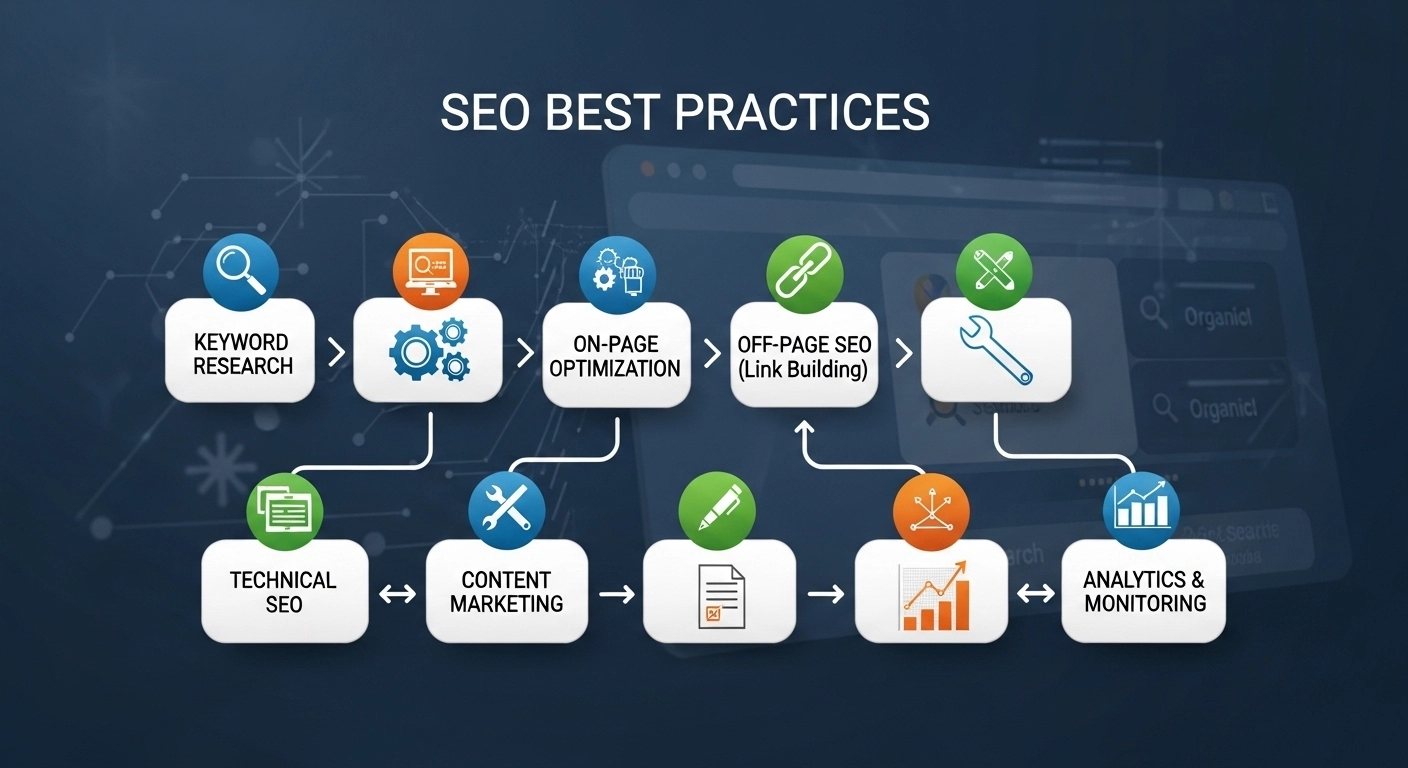
Successful SEO strategies combine several important elements:
- Keyword research
- Content optimization
- Technical SEO
- Link building
- User experience optimization
- Website performance
- Authority signals
Ignoring any of these elements can limit your SEO success.
Keyword Research: The Foundation of SEO
Keyword research helps identify the phrases people use when searching online.
Choosing the right keywords ensures your content matches what users are actively looking for.
Types of Keywords to Target
Short-Tail Keywords
Short keywords usually contain one or two words.
Example:
- SEO tips
- SEO tools
These keywords have high search volume but strong competition.
Long-Tail Keywords
Long-tail keywords are longer and more specific.
Examples include:
- SEO best practices for beginners
- SEO best practices for small businesses
- How to improve SEO rankings
Long-tail keywords often convert better because they match clear user intent.
Semantic and NLP Keywords
Search engines now analyze context rather than just keywords.
Examples of related semantic keywords:
- search engine optimization strategies
- website ranking factors
- on-page SEO techniques
- technical SEO improvements
Including these variations strengthens topical relevance.
On-Page SEO Best Practices
On-page SEO focuses on optimizing individual web pages so they rank higher in search engines.
Optimize Title Tags and Meta Descriptions
Title tags are one of the most important ranking factors.
Title Tag Best Practices
- Include your primary keyword
- Keep length under 60 characters
- Make titles compelling for clicks
- Avoid duplicate titles
Meta descriptions should summarize the page clearly and encourage users to click.
Use Proper Heading Structure
Search engines use headings to understand page structure.
Best Heading Practices
Use a logical hierarchy:
- H1 for the main title
- H2 for main sections
- H3 for supporting topics
- H4 for micro topics
This structure improves both readability and SEO.
Optimize Content for Search Intent
Google prioritizes pages that satisfy the user’s search intent.
Four Types of Search Intent
- Informational – Learning about a topic
- Navigational – Finding a specific website
- Transactional – Making a purchase
- Commercial – Research before buying
Matching content to the correct intent improves rankings dramatically.
Content Optimization for SEO
High-quality content is the most important ranking factor.
Search engines reward pages that provide useful, comprehensive, and trustworthy information.
Create High-Quality Content
Quality content should:
- Answer user questions
- Provide unique insights
- Include expert knowledge
- Offer actionable advice
Content Quality Framework
Depth
Cover topics thoroughly with supporting sections.
Accuracy
Ensure information is factual and updated.
Clarity
Use simple language and logical structure.
Value
Provide insights readers cannot easily find elsewhere.
Optimize Content Length
Longer content often performs better in search results because it covers topics more comprehensively.
However, quality matters more than word count.
Aim for:
- 1,500–2,500 words for competitive topics
- Clear sections and subtopics
- Practical insights and examples
Technical SEO Best Practices
Technical SEO ensures search engines can crawl and index your website properly.
Without technical optimization, even great content may struggle to rank.
Improve Website Speed
Page speed is a major ranking factor.
Slow websites reduce both rankings and conversions.
Ways to Improve Website Speed
- Optimize images
- Use browser caching
- Minimize CSS and JavaScript
- Use a reliable hosting provider
- Enable content delivery networks (CDNs)
Fast websites improve both SEO and user experience.
Ensure Mobile-Friendly Design
Most searches now happen on mobile devices.
Google uses mobile-first indexing, meaning it evaluates the mobile version of websites first.
Mobile SEO Checklist
- Responsive design
- Fast loading pages
- Readable text sizes
- Easy navigation
- Proper spacing for buttons
Building High-Quality Backlinks
Backlinks remain one of Google’s strongest ranking signals.
Links from authoritative websites signal trust and credibility.
Types of High-Quality Backlinks
Valuable backlinks include:
- Editorial mentions
- Guest posts
- Industry partnerships
- Media coverage
- Educational resources
Avoid spammy link-building techniques, which can lead to penalties.
Ethical Link Building Strategies
Create Link-Worthy Content
Content that attracts links naturally includes:
- Research studies
- Industry reports
- Ultimate guides
- Data-driven content
Outreach and Partnerships
Building relationships with bloggers, journalists, and industry websites can lead to valuable backlinks.
User Experience and SEO
Google increasingly prioritizes user experience.
Websites that provide positive experiences often rank higher.
Core Web Vitals
Core Web Vitals measure user experience factors including:
- Page loading speed
- Interactivity
- Visual stability
Optimizing these metrics improves both SEO and engagement.
Improve Website Navigation
Good navigation helps users find information quickly.
Navigation Best Practices
- Clear menu structure
- Logical page hierarchy
- Internal linking between pages
- Search functionality
These improvements also help search engines crawl websites more effectively.
Optimizing for Voice Search and AI Search
Search behavior continues to evolve as voice assistants and AI search tools grow.
Websites must adapt their SEO strategies accordingly.
Voice Search Optimization
Voice searches tend to be longer and conversational.
Examples include:
- “What are the best SEO best practices for beginners?”
- “How can I improve my website ranking?”
Voice SEO Tips
- Use natural language
- Answer questions directly
- Optimize FAQ sections
- Target long-tail keywords
E-E-A-T: The Future of SEO Authority
Google evaluates websites based on Experience, Expertise, Authority, and Trust.
This framework is critical for ranking competitive content.
How to Demonstrate E-E-A-T
Show Real Experience
Include case studies, examples, and practical insights.
Establish Expertise
Publish in-depth content written by knowledgeable professionals.
Build Authority
Earn mentions and backlinks from reputable websites.
Increase Trust
Include:
- Author profiles
- Secure websites (HTTPS)
- Transparent business information
- Customer testimonials
Strong E-E-A-T signals improve credibility and rankings.
Future SEO Trends and Algorithm Updates
SEO constantly evolves as search engines improve their algorithms.
Businesses must adapt to stay competitive.
Key Future SEO Trends
Important developments include:
- AI-powered search engines
- Semantic search improvements
- Zero-click search results
- Video and visual search
- Entity-based SEO
Successful SEO strategies will focus on high-quality content, authority, and user experience.
FAQ: SEO Best Practices
What are SEO best practices?
SEO best practices are proven strategies used to improve a website’s visibility in search engines. These include keyword research, content optimization, technical SEO, and backlink building.
How long does SEO take to show results?
SEO typically takes 3–6 months to produce noticeable improvements. Competitive industries may require longer to achieve top rankings.
What is the most important SEO ranking factor?
High-quality content that satisfies search intent remains the most important ranking factor, followed by backlinks and technical SEO.
How often should SEO content be updated?
SEO content should be reviewed and updated every 6–12 months to maintain accuracy, freshness, and ranking performance.
Do backlinks still matter for SEO?
Yes. Backlinks from authoritative websites are one of the strongest signals search engines use to evaluate credibility and ranking potential.
Is technical SEO necessary?
Yes. Technical SEO ensures search engines can properly crawl, index, and understand your website.
What is the difference between on-page SEO and off-page SEO?
- On-page SEO focuses on optimizing content and page elements.
- Off-page SEO involves external signals like backlinks and brand mentions.
Conclusion
Implementing the right SEO best practices is essential for businesses that want to compete online and achieve long-term growth.
Successful SEO strategies combine multiple elements, including:
- Strategic keyword research
- High-quality content creation
- Technical website optimization
- Authoritative backlinks
- Excellent user experience
- Strong E-E-A-T signals
Search engines continue to evolve with AI and semantic technologies, making it more important than ever to focus on valuable content and user-focused optimization.
Businesses that consistently apply these strategies will build stronger search visibility, attract more organic traffic, and establish lasting digital authority.
By following the SEO best practices outlined in this guide, you can create a powerful foundation for sustainable search engine success.
