
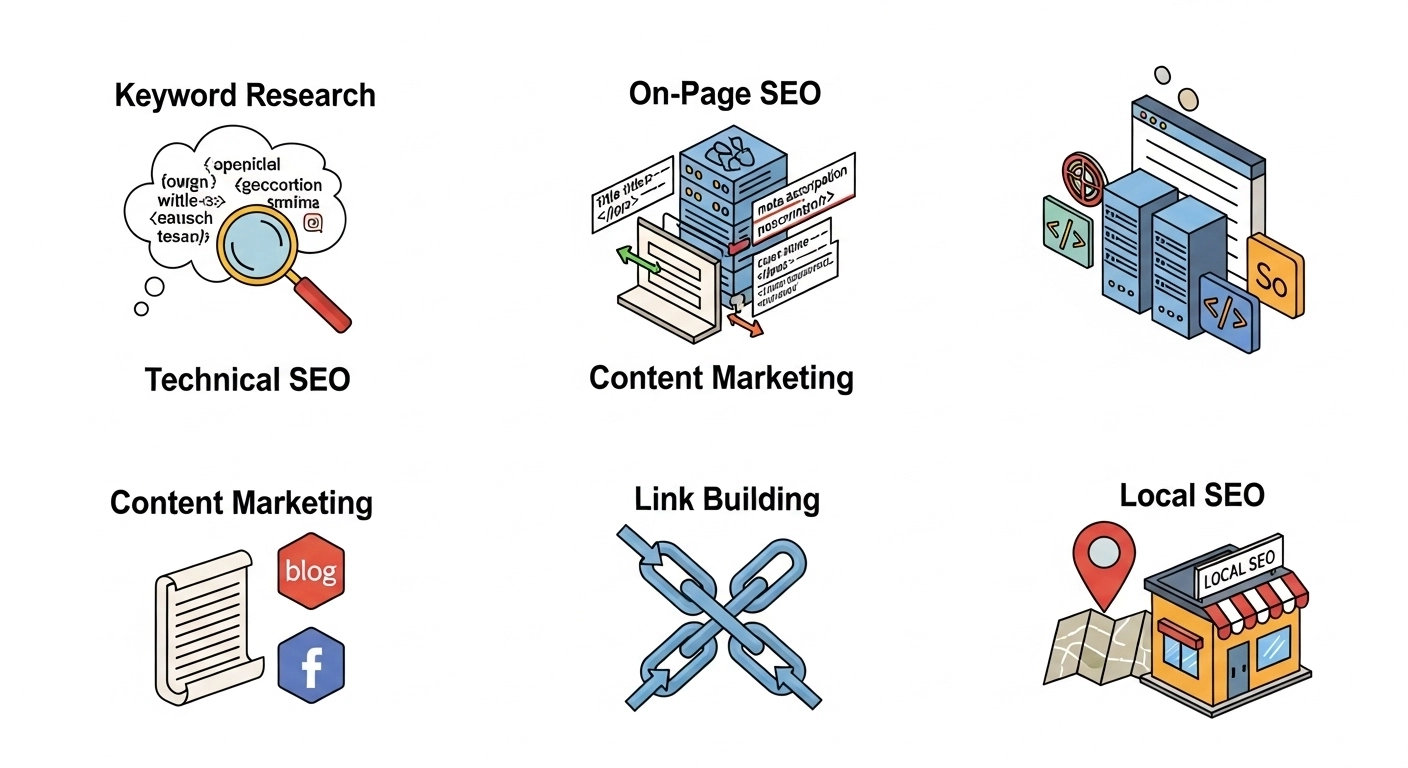
If your website is not visible on Google, you are losing potential customers every day. With billions of searches happening daily, businesses that understand Google SEO gain a massive competitive advantage.
Google SEO (Search Engine Optimization) is the process of optimizing your website so it ranks higher in Google search results. Higher rankings mean more visibility, more traffic, and more potential customers.
However, modern SEO is no longer just about keywords. Google now evaluates content quality, user experience, search intent, expertise, trust signals, and semantic relevance.
To succeed today, businesses must optimize for:
- Google’s search algorithms
- AI-powered search engines
- Semantic search and NLP
- Voice search queries
- Featured snippets
- User experience signals
This comprehensive guide will teach you how Google SEO works, the strategies that drive rankings, and how to build a website that dominates search results for years to come.
What Is Google SEO and Why It Matters
H3: Understanding Google Search Engine Optimization
Google SEO refers to optimizing a website so it appears higher in Google’s organic search results.
Search engines use complex algorithms to evaluate websites and determine which pages best match a user’s query.
Google analyzes hundreds of ranking signals including:
- Content relevance
- Keyword intent
- Backlinks
- Page speed
- Mobile usability
- User engagement
- Authority and trust
The goal of SEO is to help Google understand your content while delivering the best experience to users.
H3: Benefits of Google SEO for Businesses
A strong SEO strategy delivers long-term growth.
Key advantages include:
- Increased organic traffic
- Higher search engine rankings
- Improved brand credibility
- Better lead generation
- Reduced advertising costs
- Sustainable digital growth
Unlike paid advertising, SEO continues to generate traffic long after content is published.
How Google Search Works
Understanding how Google works is essential for mastering SEO.
Google follows three main processes:
- Crawling
- Indexing
- Ranking
H3: Crawling
Google uses automated programs called Googlebots to discover new and updated pages across the internet.
H4 Ways to Improve Crawling
- Submit XML sitemaps
- Fix broken links
- Improve internal linking
- Optimize website structure
- Use robots.txt correctly
Good site architecture helps Google bots navigate your website efficiently.
H3: Indexing
Once pages are discovered, Google analyzes and stores them in its index.
During indexing, Google evaluates:
- Page content
- Keywords
- images
- structured data
- meta tags
Proper on-page SEO ensures your content is correctly understood.
H3: Ranking
When someone searches for a query, Google retrieves indexed pages and ranks them based on relevance and quality.
Ranking factors include:
- Content quality
- Backlinks
- User engagement
- Page experience
- Semantic relevance
Core Google SEO Ranking Factors
To rank on Google, websites must satisfy multiple ranking signals.
H3: High-Quality Content
Content remains the foundation of SEO success.
Google rewards content that demonstrates:
- Expertise
- Experience
- Authority
- Trustworthiness (E-E-A-T)
H4 Content Optimization Framework
To create SEO-friendly content:
- Research search intent
- Use semantic keywords
- Provide detailed answers
- Add internal links
- Update content regularly
High-quality content improves both rankings and user satisfaction.
H3: Keyword Optimization
Keywords help search engines understand page topics.
However, modern SEO focuses on keyword clusters and semantic context, not just exact keywords.
Examples of related keywords for Google SEO:
- search engine optimization
- SEO strategies
- Google ranking factors
- organic search traffic
- website optimization
H3: Backlinks and Authority
Backlinks remain one of the strongest ranking signals.
Backlinks are links from other websites pointing to your site.
High-quality backlinks signal to Google that your content is trustworthy.
H4 Ways to Build Backlinks
- Guest blogging
- Digital PR
- Content marketing
- Industry partnerships
- Resource link building
Quality matters more than quantity.
H3: Technical SEO
Technical SEO ensures your website is easily accessible for search engines.
Key technical factors include:
- Website speed
- Mobile responsiveness
- secure HTTPS
- structured data
- crawlability
- clean URL structure
Technical issues can prevent even great content from ranking.
On-Page Google SEO Best Practices
On-page SEO focuses on optimizing elements directly on your website.
H3: Title Tags and Meta Descriptions
Your title tag is one of the most important ranking signals.
Best practices:
- Include your primary keyword
- Keep titles under 60 characters
- Make them compelling for clicks
Meta descriptions should summarize the page and encourage users to visit.
H3: Header Tags (H1, H2, H3)
Header tags structure your content and improve readability.
Benefits include:
- Better user experience
- Improved SEO structure
- Enhanced semantic relevance
Each page should have one H1 and multiple H2/H3 headings.
H3: Internal Linking
Internal links connect pages within your website.
Benefits include:
- Better site navigation
- Improved crawlability
- Stronger topical authority
- Longer user engagement
Technical Google SEO Optimization
Technical SEO strengthens the foundation of your website.
H3: Page Speed Optimization
Fast websites rank better and provide better user experience.
H4 Speed Optimization Tips
- Compress images
- Use caching
- Minify CSS and JavaScript
- Use a fast hosting provider
- Implement a CDN
H3: Mobile Optimization
Google uses mobile-first indexing.
Your website must perform well on smartphones and tablets.
Key requirements:
- Responsive design
- Fast loading
- Easy navigation
- readable text
H3: Structured Data and Schema Markup
Structured data helps Google understand your content better.
Schema markup can enhance search results with:
- star ratings
- FAQs
- product information
- rich snippets
Advanced Google SEO Strategies
Modern SEO requires adapting to new search technologies.
H3: Semantic SEO
Google understands context and relationships between words.
Semantic SEO involves:
- keyword clusters
- topic coverage
- entity optimization
- contextual relevance
This approach improves topical authority.
H3: Voice Search Optimization
Voice searches are more conversational.
Examples include:
- “What is Google SEO?”
- “How do I improve my Google rankings?”
Optimizing for natural language queries helps capture voice traffic.
H3: AI Search Optimization
AI search engines and tools are changing SEO.
To stay competitive:
- Create expert-level content
- Provide clear answers
- Use structured headings
- Build topical authority
AI systems prioritize trustworthy and well-structured content.
Common Google SEO Mistakes to Avoid
Many websites struggle because of avoidable SEO errors.
Common mistakes include:
- Keyword stuffing
- Duplicate content
- Slow website speed
- Poor mobile experience
- Thin content
- Lack of backlinks
Fixing these issues can dramatically improve rankings.
Google SEO Tools Every Marketer Should Use
Professional SEO requires data and insights.
Popular SEO tools include:
- Google Search Console
- Google Analytics
- Ahrefs
- SEMrush
- Screaming Frog
- Moz
These tools help track performance, analyze competitors, and discover opportunities.
Frequently Asked Questions (FAQ)
What is Google SEO?
Google SEO is the process of optimizing a website to improve its ranking in Google’s organic search results.
How long does Google SEO take to work?
SEO results typically take 3–6 months depending on competition, website authority, and optimization quality.
Is Google SEO better than paid advertising?
SEO provides long-term traffic without ongoing ad costs, while paid ads deliver immediate visibility.
Both strategies work best when used together.
What are the most important Google ranking factors?
Major ranking factors include:
- High-quality content
- Backlinks
- Page experience
- Keyword relevance
- Mobile optimization
Can beginners learn Google SEO?
Yes. With the right strategies, tools, and consistent practice, beginners can successfully learn SEO.
How often should SEO content be updated?
Updating content every 6–12 months helps maintain rankings and ensures accuracy.
Does Google penalize bad SEO practices?
Yes. Practices like keyword stuffing, spam backlinks, and duplicate content can harm rankings.
Conclusion
Mastering Google SEO is one of the most powerful ways to grow your website traffic, authority, and online presence.
By focusing on:
- high-quality content
- strong keyword strategy
- technical optimization
- authoritative backlinks
- excellent user experience
you can build a website that ranks consistently on Google.
SEO is not a one-time task—it is an ongoing strategy that evolves with search engine algorithms and user behavior.
Businesses that invest in modern, ethical SEO practices will continue to dominate search results and attract high-quality traffic.
Start implementing these Google SEO strategies today and position your website for long-term success in the digital landscape.
