
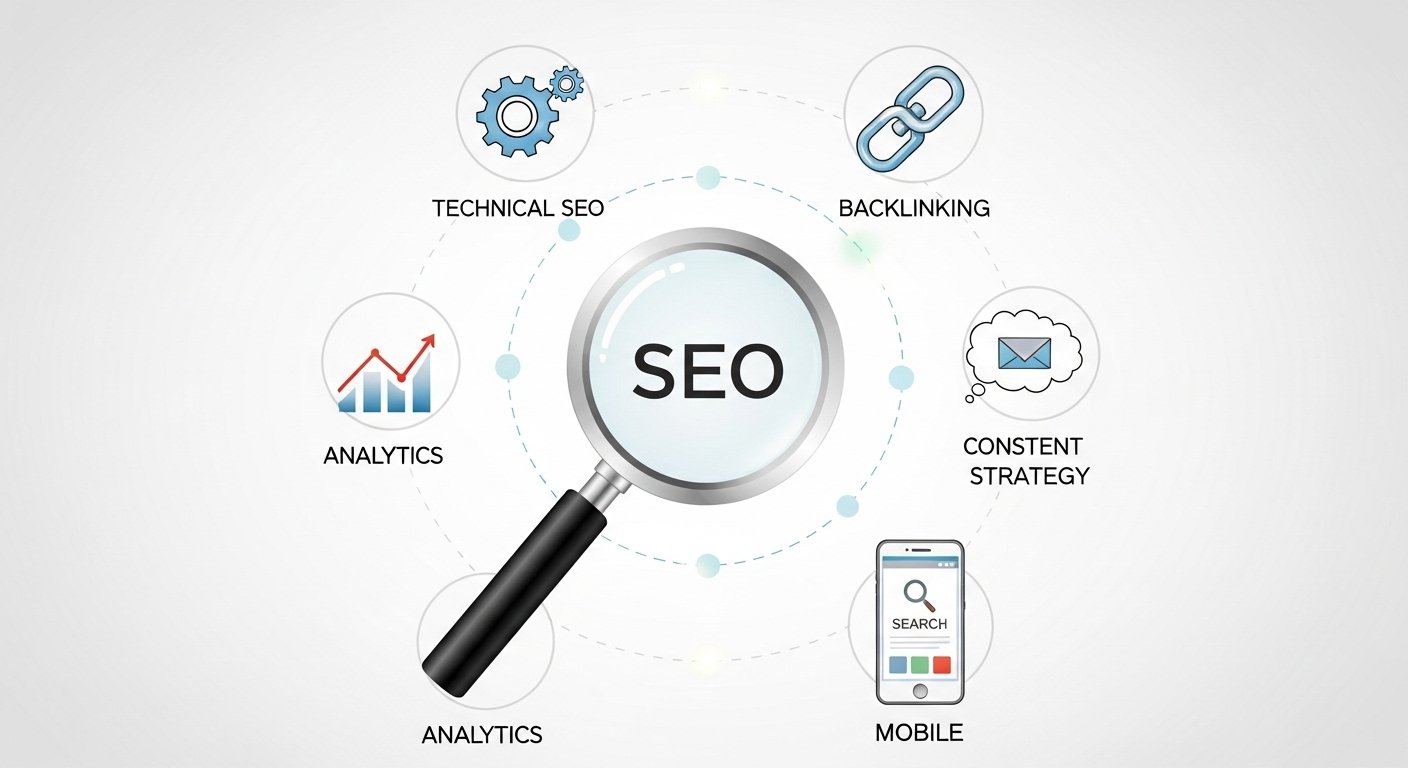
In today’s digital economy, visibility on search engines can determine whether a business thrives or disappears online. Every day, billions of searches happen on Google, and businesses compete for the top positions. This is where SEO (Search Engine Optimization) becomes essential.
SEO is the process of improving a website so that it ranks higher in search engine results pages (SERPs), attracts qualified traffic, and converts visitors into customers. When implemented correctly, SEO becomes one of the most powerful long-term marketing strategies for sustainable growth.
Modern SEO is no longer just about inserting keywords into content. Search engines now evaluate content quality, search intent, user experience, semantic relevance, authority, and trust signals. Websites that align with these factors are more likely to rank and maintain long-term visibility.
In this comprehensive guide, you’ll learn everything about SEO—from fundamental principles to advanced strategies used by top-ranking websites. Whether you’re a business owner, marketer, or beginner, this article will help you build a future-proof SEO strategy designed to perform well in Google, AI search engines, and voice search platforms.
What Is SEO and Why It Matters for Online Success
Search Engine Optimization (SEO) is the practice of optimizing websites so they appear higher in organic search results.
Unlike paid advertising, SEO focuses on earning traffic naturally through optimized content and website improvements.
Benefits of SEO for Businesses
Businesses invest in SEO because it provides long-term advantages:
- Higher organic search rankings
- Increased website traffic
- Stronger online visibility
- Better brand credibility
- Higher lead generation and conversions
SEO also improves overall website quality and user experience, making it valuable beyond search engines.
How Search Engines Work
To understand SEO, you must understand how search engines operate.
H3: Crawling
Search engines use automated bots (also called spiders) to scan the internet and discover web pages.
H3: Indexing
After crawling a page, search engines store the information in an index database.
H3: Ranking
When users search for information, algorithms evaluate indexed pages based on relevance, authority, and user experience to determine rankings.
Core Components of Modern SEO
Successful SEO involves several interconnected components working together.
H3: On-Page SEO
On-page SEO refers to optimizing elements directly on your website.
Important on-page factors include:
- Title tags
- Meta descriptions
- Heading structure
- Keyword placement
- Content quality
- Internal linking
H4 On-Page SEO Optimization Checklist
To improve on-page SEO:
- Place the primary keyword in the title tag.
- Use descriptive headings (H1, H2, H3).
- Write helpful, informative content.
- Optimize images with alt text.
- Add internal links to related pages.
H3: Technical SEO
Technical SEO ensures search engines can properly crawl and understand your website.
Important elements include:
- Site speed optimization
- Mobile-friendly design
- XML sitemaps
- Secure HTTPS connections
- Structured data markup
H4 Technical SEO Best Practices
Follow these practices:
- Improve page loading speed
- Fix broken links
- Optimize Core Web Vitals
- Use clean URL structures
- Implement schema markup
H3: Off-Page SEO
Off-page SEO refers to actions taken outside your website to improve authority.
The most important factor is backlinks.
Backlinks are links from other websites pointing to your site. They act as trust signals for search engines.
H4 Effective Link Building Strategies
- Guest blogging
- Digital PR campaigns
- Industry partnerships
- High-quality content promotion
- Resource link building
Keyword Research: The Foundation of SEO
Keyword research helps identify the search terms your audience uses.
By targeting the right keywords, you attract visitors who are actively searching for your products, services, or information.
H3 Types of SEO Keywords
There are several categories of keywords used in SEO.
Short-Tail Keywords
Example:
SEO
High search volume but high competition.
Long-Tail Keywords
Example:
“How to improve SEO rankings”
Lower competition and higher conversion potential.
LSI Keywords
Latent Semantic Indexing keywords help search engines understand topic context.
Examples:
- search engine ranking
- website optimization
- organic search traffic
- Google algorithm updates
H3 How to Conduct Keyword Research
H4 Step-by-Step Keyword Research Process
- Identify your target audience.
- Brainstorm relevant search topics.
- Use keyword research tools.
- Analyze search intent.
- Select keywords with strong opportunity.
Popular SEO tools include:
- Google Search Console
- SEMrush
- Ahrefs
- Moz
- Ubersuggest
Content Optimization for SEO
High-quality content is the backbone of SEO success.
Search engines prioritize content that answers user questions clearly and comprehensively.
H3 Characteristics of SEO-Friendly Content
Strong SEO content includes:
- Clear topic structure
- Helpful information
- Keyword relevance
- Engaging writing style
- Up-to-date data
H3 Semantic SEO and NLP Optimization
Search engines now use Natural Language Processing (NLP) to understand meaning.
Semantic SEO focuses on topic coverage rather than simple keyword repetition.
Example semantic terms related to SEO:
- search ranking factors
- organic traffic growth
- content optimization strategies
- website visibility
SEO for User Experience (UX)
User experience plays a major role in rankings.
Google analyzes behavior signals such as:
- bounce rate
- time on page
- page load speed
- mobile usability
Websites that provide excellent user experiences are rewarded with better rankings.
Voice Search and AI Search Optimization
Search behavior is evolving due to voice assistants and AI search engines.
Examples include:
- Google Assistant
- Siri
- Alexa
Voice queries tend to be conversational.
Example voice query:
“How can I improve SEO for my website?”
To optimize for voice search:
- Use natural language phrases
- Answer common questions
- Write clear and concise explanations
SEO Trends and Future Algorithm Updates
SEO constantly evolves as search engines update their algorithms.
Key trends shaping the future of SEO include:
- AI-driven search results
- semantic content optimization
- user experience signals
- entity-based search
- E-E-A-T signals
Businesses that focus on high-quality content and expertise will continue to succeed.
Common SEO Mistakes to Avoid
Even experienced marketers make SEO mistakes that hurt rankings.
H3 Keyword Stuffing
Overusing keywords makes content unnatural and may trigger penalties.
H3 Thin Content
Pages with little useful information rarely rank well.
H3 Ignoring Mobile Optimization
Most searches occur on mobile devices.
H3 Poor Internal Linking
Internal links help search engines understand website structure.
SEO Strategy Framework for Long-Term Growth
Building a successful SEO strategy requires consistent effort.
H4 Proven SEO Growth Framework
- Conduct keyword research
- Create high-quality content
- Optimize on-page elements
- Build authoritative backlinks
- Improve technical SEO
- Monitor performance and adjust strategy
SEO success typically takes 3–6 months, but the long-term benefits are significant.
Frequently Asked Questions (FAQ)
What is SEO in simple terms?
SEO (Search Engine Optimization) is the process of improving a website so it ranks higher on search engines like Google and attracts more organic traffic.
Why is SEO important for businesses?
SEO helps businesses increase online visibility, attract targeted visitors, and generate leads without relying solely on paid advertising.
How long does SEO take to work?
Most websites start seeing SEO improvements within 3–6 months, depending on competition, website authority, and optimization efforts.
What are the main types of SEO?
The three main types of SEO are:
- On-page SEO
- Technical SEO
- Off-page SEO
Each plays a role in improving search rankings.
Is SEO better than paid advertising?
SEO and paid advertising serve different purposes. SEO builds long-term organic traffic, while paid ads deliver immediate visibility.
Can beginners learn SEO?
Yes. Anyone can learn SEO by understanding search engines, keyword research, content optimization, and website performance.
What tools are best for SEO?
Popular SEO tools include:
- Google Search Console
- Ahrefs
- SEMrush
- Moz
- Screaming Frog
These tools help analyze keywords, backlinks, and website performance.
Conclusion
SEO remains one of the most powerful strategies for growing a website and attracting consistent organic traffic.
A strong SEO strategy combines multiple elements:
- keyword research
- content optimization
- technical improvements
- link building
- user experience enhancement
Search engines continue to evolve, but one principle remains constant: websites that provide valuable, trustworthy, and well-structured content will rank higher.
By implementing the strategies in this guide, businesses and marketers can build sustainable visibility, increase traffic, and stay competitive in the ever-changing digital landscape.
SEO is not a one-time effort—it is a long-term investment that delivers compounding results over time.
