
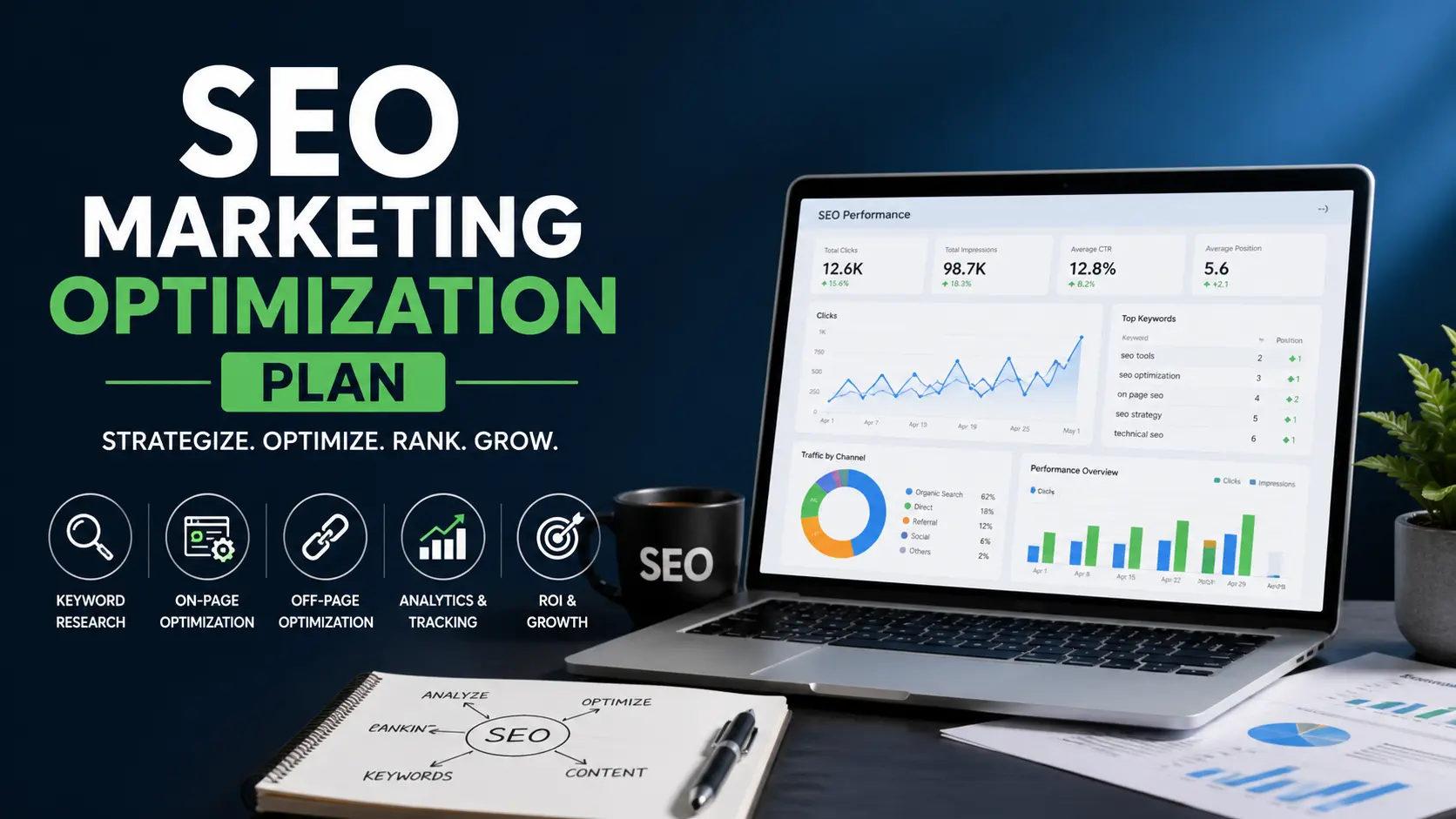
If you want consistent organic traffic, better rankings, and higher-quality leads, you need more than random SEO tactics—you need a structured SEO marketing optimization plan.
This guide breaks down exactly how to build one that actually works in 2026, using clear steps, real-world examples, and strategies you can apply immediately.
What Is an SEO Marketing Optimization Plan?
An SEO marketing optimization plan is a structured roadmap that helps you improve your website’s visibility in search engines like Google.
It connects all SEO activities—keyword research, content creation, technical improvements, and link building—into one clear system.
Instead of guessing what to do next, you follow a plan designed to:
- Increase organic traffic
- Improve keyword rankings
- Boost conversions
- Strengthen domain authority
- Support long-term growth
Think of it as the blueprint for sustainable search engine success.
Step 1: Define Clear SEO Goals
Before touching keywords or content, you need direction. Without goals, SEO becomes random effort.
Common SEO goals include:
- Increase organic traffic by 30–50%
- Rank on page 1 for target keywords
- Improve blog-to-lead conversions
- Grow ecommerce product visibility
- Build topical authority in a niche
Example:
A small business selling skincare products may focus on:
“Increase organic sales by ranking for high-intent keywords like ‘best acne cream for sensitive skin’.”
Clear goals help shape every SEO decision.
Step 2: Perform a Full SEO Audit
An SEO audit shows what’s working and what’s holding your website back.
Key areas to check:
1. Technical SEO
- Site speed
- Mobile responsiveness
- Indexing issues
- Broken links
- Crawl errors
2. On-Page SEO
- Title tags and meta descriptions
- Header structure (H1, H2, H3)
- Keyword placement
- Content quality
3. Off-Page SEO
- Backlink profile
- Domain authority
- Toxic links
Example:
If your pages are not indexed properly, even the best content will not rank.
Fixing technical issues is often the fastest SEO win.
Step 3: Build a Strong Keyword Strategy
Keyword research is the backbone of any SEO marketing optimization plan.
But modern SEO is not just about high-volume keywords—it’s about search intent.
Focus on 3 types of keywords:
1. Informational keywords
People looking for answers
Example: “what is SEO marketing optimization”
2. Commercial keywords
People comparing options
Example: “best SEO tools for small business”
3. Transactional keywords
People ready to buy
Example: “SEO agency pricing packages”
Pro Tip:
Target long-tail keywords first. They are easier to rank and bring highly targeted traffic.
Step 4: Optimize On-Page SEO
On-page SEO helps search engines understand your content.
Key optimization elements:
Title Tags
Make them clear, keyword-focused, and clickable.
Meta Descriptions
Write compelling summaries that increase CTR.
Headings Structure
Use logical hierarchy:
- H1 = main topic
- H2 = sections
- H3 = supporting points
Internal Linking
Link related pages together to improve:
- Crawlability
- User experience
- Authority flow
Example:
If you write about SEO tools, link to your keyword research and analytics guides.
Step 5: Create High-Quality Content That Ranks
Content is the core of SEO success.
Google rewards content that is:
- Helpful and detailed
- Easy to read
- Solves real problems
- Structured properly
Content types to include:
- Blog posts
- Guides and tutorials
- Case studies
- Product pages
- Comparison articles
Example:
Instead of writing:
“SEO tips for beginners”
Write:
“Step-by-Step SEO Marketing Optimization Plan for Beginners in 2026”
The second one is more specific and valuable.
Step 6: Improve Technical SEO Performance
Technical SEO ensures your website runs smoothly for both users and search engines.
Key improvements:
Site Speed Optimization
- Compress images
- Use caching
- Minimize scripts
Mobile Optimization
Most traffic comes from mobile, so your site must load perfectly on all devices.
Fix Crawl Errors
Ensure search engines can access all important pages.
Structured Data
Helps Google understand your content better (rich snippets, ratings, FAQs).
Step 7: Build High-Quality Backlinks
Backlinks are still one of the strongest ranking signals.
But quality matters more than quantity.
Effective link-building methods:
- Guest posting on relevant websites
- Creating shareable content (guides, stats, tools)
- Outreach to bloggers and journalists
- Digital PR campaigns
Example:
A detailed “SEO checklist for 2026” can attract natural backlinks from bloggers.
Step 8: Track SEO Performance Regularly
Without tracking, you can’t improve.
Important metrics:
- Organic traffic growth
- Keyword rankings
- Click-through rate (CTR)
- Bounce rate
- Conversion rate
Use tools like:
- Google Analytics
- Google Search Console
Tip:
Review performance every 30 days and adjust your strategy based on results.
Step 9: Continuously Optimize and Update Content
SEO is not a one-time job.
Google prefers fresh and updated content.
What to update:
- Old statistics
- Outdated examples
- Weak sections
- Missing keywords
Example:
A blog from 2023 about SEO trends should be updated with 2026 strategies to maintain rankings.
Simple SEO Marketing Optimization Plan Checklist
Here’s a quick summary:
- Set clear SEO goals
- Perform full site audit
- Research keywords by intent
- Optimize on-page SEO
- Create high-quality content
- Fix technical SEO issues
- Build backlinks
- Track performance
- Update content regularly
FAQ: SEO Marketing Optimization Plan
1. What is an SEO marketing optimization plan?
It’s a structured strategy that combines keyword research, content creation, technical SEO, and link building to improve search rankings and organic traffic.
2. How long does SEO take to show results?
Usually 3–6 months, depending on competition, content quality, and website authority.
3. Do small businesses need an SEO plan?
Yes. A clear SEO plan helps small businesses compete with larger brands by targeting niche keywords and local search traffic.
4. What is the most important part of SEO?
High-quality content combined with strong keyword strategy and technical SEO creates the best results.
5. Can SEO work without backlinks?
Yes, but backlinks significantly speed up ranking and improve authority.
Conclusion
A successful SEO marketing optimization plan is not about doing everything—it’s about doing the right things in the right order.
When you combine clear goals, strong keyword strategy, optimized content, technical improvements, and consistent tracking, you build a system that delivers long-term organic growth.
SEO is not instant—but with the right plan, it becomes predictable and scalable.
