
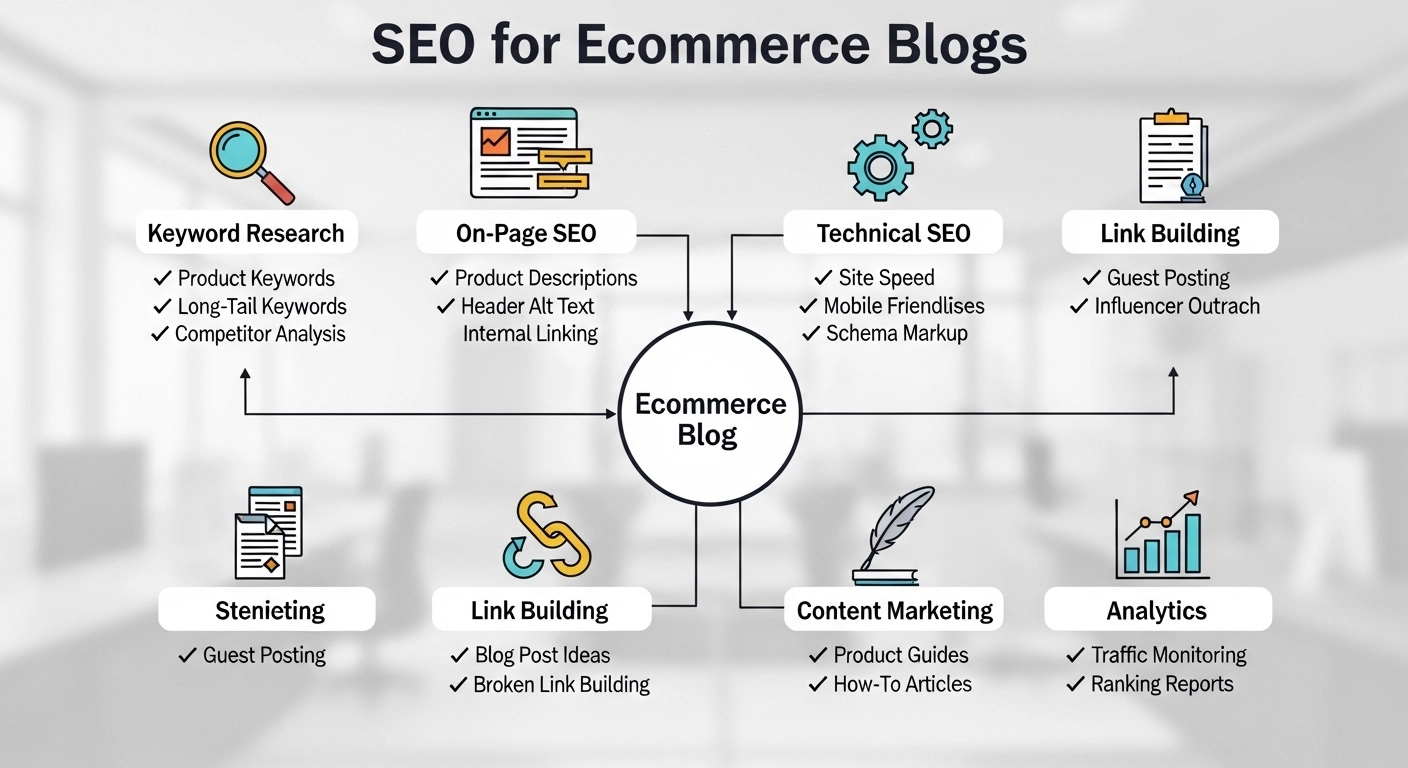
If you run an online store, your blog is more than just “extra content.” It’s one of your most powerful tools for bringing in organic traffic, building trust, and turning readers into buyers.
But here’s the catch—most ecommerce blogs don’t perform well because they’re not built with SEO in mind.
This guide breaks down SEO for ecommerce blogs in a practical, easy way so you can actually use it to grow your store—not just read about it.
Why SEO Matters for Ecommerce Blogs
Your product pages alone are rarely enough to rank on Google for competitive keywords. That’s where blogging comes in.
An optimized ecommerce blog helps you:
- Attract people who are still researching (not ready to buy yet)
- Rank for long-tail keywords your product pages can’t target
- Build authority in your niche
- Support internal linking to boost product page rankings
- Increase overall site traffic without paid ads
For example, instead of trying to rank a product page for “running shoes,” you can write a blog like:
“Best running shoes for flat feet in 2026”
That blog brings in searchers who are actively looking for solutions—and gently guides them toward your products.
Keyword Research for Ecommerce Blogs
Good SEO starts with choosing the right topics.
Instead of guessing, focus on what your customers are actually searching for.
High-performing keyword types:
- Problem-based keywords: “how to fix dry skin in winter”
- Comparison keywords: “Nike vs Adidas running shoes”
- Best/product roundups: “best laptops under $1000”
- Informational guides: “how to choose a gaming chair”
Use tools like Google Search, Ahrefs, or even Amazon autocomplete to find real search queries.
Tip: Focus on long-tail keywords. They’re easier to rank and bring more targeted traffic.
Writing Blog Content That Ranks and Converts
Ranking on Google is only half the job. Your content also needs to convince readers to take action.
Here’s how to structure your ecommerce blog posts:
1. Start with a clear intent
Match what the reader is looking for immediately. Don’t waste time with long introductions.
2. Use simple headings
Break content into sections that are easy to scan.
3. Solve real problems
Don’t just describe products—explain when, why, and how to use them.
4. Add product links naturally
Instead of forcing sales, use helpful suggestions:
“If you need extra cushioning, this memory foam option works well for long-distance runners.”
5. Keep paragraphs short
Online readers skim. Short paragraphs improve readability and engagement.
On-Page SEO for Ecommerce Blogs
On-page SEO helps search engines understand your content better.
Make sure you optimize:
Title Tag
Include your main keyword naturally:
SEO for ecommerce blogs: A complete guide
Meta Description
Write a short, clear summary that encourages clicks.
URL Structure
Keep it simple:/seo-for-ecommerce-blogs
Internal Linking
Link to:
- Product pages
- Category pages
- Related blog posts
This helps distribute authority across your site.
Images
Use compressed images with descriptive alt text like:
“organic cotton t-shirt folded on wooden table”
Content Ideas for Ecommerce Blogs That Drive Sales
If you’re stuck on what to write, here are proven formats:
- “Best X for Y” guides
- “How to choose” tutorials
- Seasonal buying guides (e.g., “Best winter jackets in 2026”)
- Problem-solving posts (e.g., “How to prevent acne from masks”)
- Product comparisons
- Care and maintenance guides
These types of posts naturally attract buyers because they align with purchase intent.
Technical SEO Basics You Shouldn’t Ignore
Even great content won’t rank if your site has technical issues.
Make sure your ecommerce blog:
- Loads quickly on mobile
- Uses HTTPS
- Has clean navigation
- Avoids duplicate content
- Uses proper heading structure (H1, H2, H3)
Also, submit your sitemap to Google Search Console so your blog posts get indexed faster.
Common Mistakes in Ecommerce Blog SEO
Many store owners make these mistakes:
- Writing only promotional content (no real value)
- Ignoring keyword research
- Not linking to product pages
- Publishing inconsistent content
- Overusing keywords unnaturally
Avoiding these alone can significantly improve your rankings.
Simple SEO Checklist for Ecommerce Blogs
Before publishing any post, check:
- Does it target one main keyword?
- Does it answer a clear search intent?
- Is it easy to read and scan?
- Are internal links included?
- Is there a clear next step for the reader?
If you can tick all of these, you’re on the right track.
FAQ: SEO for Ecommerce Blogs
1. How often should I post on an ecommerce blog?
Consistency matters more than volume. Posting 2–4 high-quality articles per month is better than daily low-value content.
2. Do ecommerce blogs really increase sales?
Yes. Blogs bring in organic traffic, educate buyers, and guide them toward products over time.
3. Should I focus on product keywords or informational keywords?
Start with informational keywords. They’re easier to rank and build long-term traffic that converts later.
4. How long should ecommerce blog posts be?
Aim for 800–1500 words depending on topic depth. Focus on quality, not just length.
5. Can I use AI to write ecommerce blog content?
Yes, but always edit for accuracy, tone, and real human value before publishing.
Conclusion
Strong SEO for ecommerce blogs is not about stuffing keywords or publishing random articles. It’s about understanding your customers, solving their problems, and naturally guiding them toward your products.
When done right, your blog becomes a long-term traffic engine that keeps bringing in visitors—even when you’re not running ads.
