
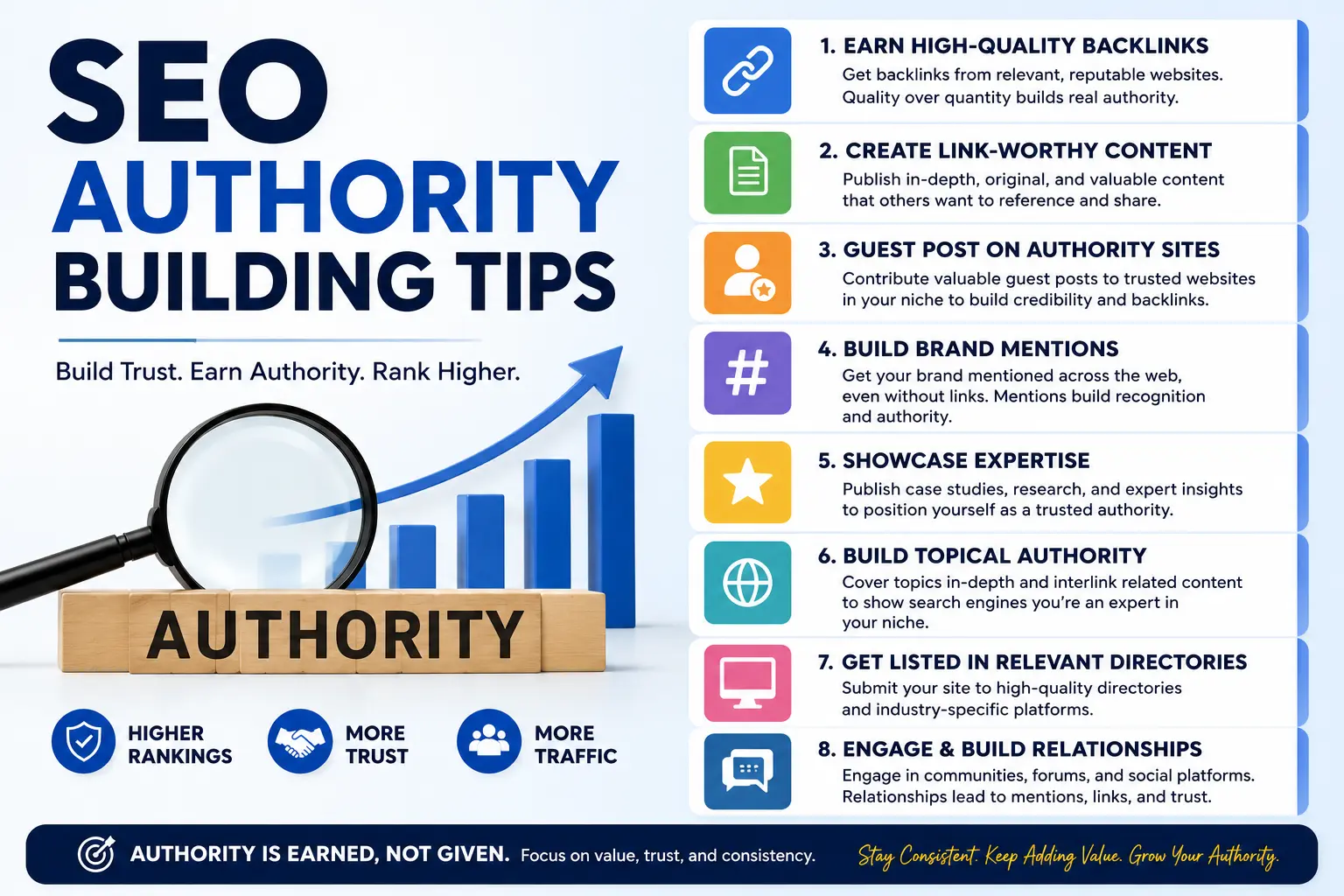
Building SEO authority is not about quick tricks or overnight rankings. It’s about becoming a trusted source in your niche so search engines and users consistently choose your content over others. When your site has authority, rankings become more stable, traffic grows naturally, and competition becomes easier to outrank.
Below are practical, real-world SEO authority building tips you can apply to grow your website the right way.
1. Create Content That Actually Solves Problems
Search engines reward content that fully satisfies user intent.
Instead of writing thin or generic posts, focus on:
- Answering specific questions clearly
- Covering topics in depth (not just surface-level info)
- Adding real examples or case insights
- Using simple language people understand
For example, instead of writing “SEO tips,” create something like:
“How to Improve Website Rankings for Small Businesses in 2026”
The more helpful your content is, the more trust you build.
2. Build Topical Authority, Not Random Articles
One of the strongest SEO authority signals is topic consistency.
Instead of publishing random posts, group your content around a core niche:
Example structure for SEO site:
- SEO basics for beginners
- Keyword research strategies
- On-page SEO guides
- Technical SEO fixes
- Link building methods
When search engines see deep coverage of one subject, they start treating your site as an authority in that space.
3. Earn High-Quality Backlinks (Not Just Any Links)
Backlinks are still one of the strongest authority signals—but quality matters more than quantity.
Focus on:
- Guest posting on relevant websites
- Getting mentions from industry blogs
- Creating link-worthy content (guides, data, tools)
- Digital PR and outreach
Avoid spammy or low-quality links. They can harm trust instead of building it.
4. Strengthen Internal Linking Structure
Internal links help search engines understand your site hierarchy and distribute authority across pages.
Best practices:
- Link related articles naturally within content
- Use descriptive anchor text
- Create pillar pages and connect supporting posts
- Avoid orphan pages (pages with no internal links)
A strong internal linking system improves both rankings and user experience.
5. Improve E-E-A-T Signals (Experience, Expertise, Authority, Trust)
Google evaluates websites based on credibility.
You can strengthen E-E-A-T by:
- Adding author bios with real expertise
- Showing real-world experience or case studies
- Using trustworthy sources
- Keeping content updated regularly
- Displaying clear contact and about pages
The more transparent and credible your site looks, the more authority it gains.
6. Optimize Content for Search Intent
Every search query has intent behind it:
- Informational (learn something)
- Commercial (compare options)
- Transactional (ready to buy)
Match your content to what users actually want. If intent is mismatched, rankings won’t hold—even if your SEO is strong.
7. Publish Consistently (Not Randomly)
Authority is built over time, not in bursts.
A consistent publishing schedule helps:
- Signal freshness to search engines
- Build audience trust
- Increase crawling frequency
Even 2–4 high-quality posts per month can outperform daily low-value content.
8. Refresh Old Content Regularly
Updating existing content is one of the fastest ways to boost authority.
Improve old posts by:
- Adding new data or examples
- Fixing outdated information
- Improving readability
- Expanding sections based on new trends
Fresh, updated content often outranks new competitors.
9. Improve User Experience Signals
Search engines track how users interact with your site.
Improve engagement by:
- Making pages easy to read
- Using short paragraphs and clear headings
- Reducing intrusive ads or popups
- Improving mobile speed
- Adding internal links for deeper browsing
Better user experience = stronger trust signals.
10. Focus on Brand Building, Not Just Keywords
Strong SEO authority comes from recognition.
When people search for your brand directly or mention it elsewhere, it signals trust to search engines.
Ways to build brand authority:
- Share content on social platforms
- Build email newsletters
- Create recognizable content style
- Engage in industry discussions
Over time, your brand becomes a ranking factor itself.
FAQ: SEO Authority Building Tips
What is SEO authority?
SEO authority is the level of trust search engines assign to your website based on content quality, backlinks, and user engagement.
How long does it take to build SEO authority?
It usually takes 3–6 months to see early results, and 6–12+ months for strong authority depending on competition and consistency.
Do backlinks still matter for authority?
Yes, but quality matters more than quantity. Relevant, trusted backlinks have a much stronger impact.
Can a new website build authority quickly?
Yes, but only with focused niche content, strong internal linking, and consistent publishing. There are no instant shortcuts.
Conclusion
Building SEO authority is not about chasing algorithms—it’s about building trust. When your content consistently helps users, earns quality links, and covers topics deeply, search engines naturally reward you with higher rankings.
The key is consistency, clarity, and long-term strategy.
