
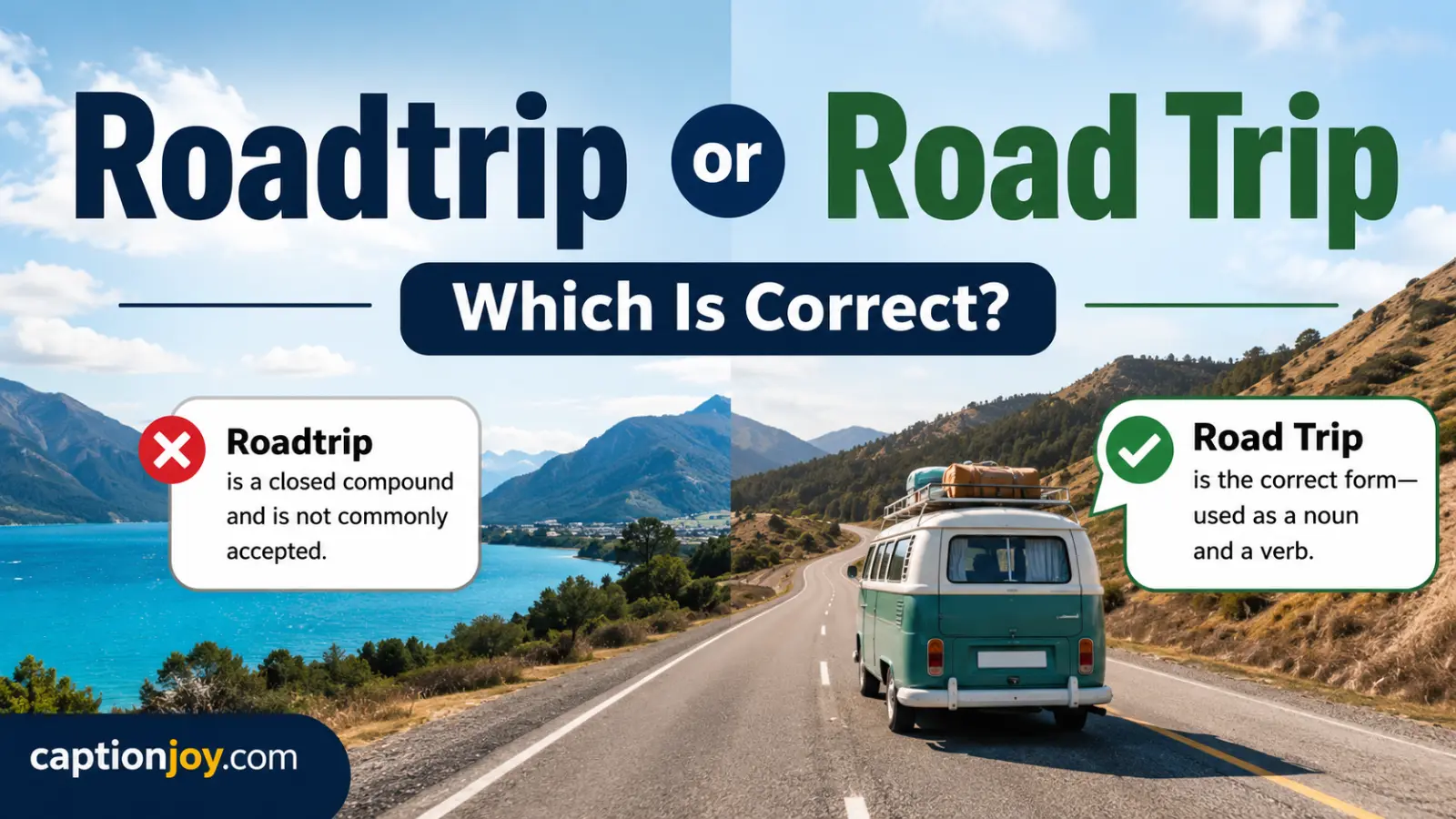
If you’ve ever searched for “roadtrip or road trip”, you’re not alone. Thousands of writers, travelers, marketers, and business owners wonder whether the term should be written as one word or two.
The short answer is simple:
“Road trip” is the standard and widely accepted spelling in American English. “Roadtrip” is considered a nonstandard variation, although it occasionally appears in branding, marketing, and informal digital content.
Understanding the difference matters for writing quality, SEO performance, and professional communication.
This guide explains when to use each version, how search engines interpret them, and what writers should do in 2026.
What Is the Correct Spelling: Roadtrip or Road Trip?
The Correct Form: Road Trip
In standard American English, road trip is written as two separate words.
Examples:
- We are planning a road trip across the Southwest.
- Summer is the perfect time for a family road trip.
- She documented her road trip through national parks.
Major dictionaries, editorial style guides, and publishing standards recognize road trip as the correct spelling.
The Nonstandard Form: Roadtrip
The single-word version, roadtrip, appears in:
- Brand names
- Mobile applications
- Marketing campaigns
- Social media hashtags
- Informal online writing
Examples:
- #Roadtrip2026
- Roadtrip Adventures
- Ultimate Roadtrip Planner
While readers understand the meaning, it is generally not considered correct in formal or professional writing.
Why Does the Confusion Exist?
English frequently combines two words into one over time.
Examples include:
- Website
- Notebook
- Smartphone
Many compound nouns evolve from two words into one word after years of common usage.
The term road trip may eventually follow that path, but in 2026, most style authorities still recommend using two words.
Quick Answer
| Version | Status | Recommended Usage |
| Road trip | Correct | Formal and informal writing |
| Roadtrip | Nonstandard | Branding, hashtags, informal use |
Why Search Engines Understand Both Versions
Modern search engines use semantic understanding rather than exact keyword matching.
If someone searches:
- road trip ideas
- roadtrip ideas
- best roadtrip routes
- best road trip routes
Search engines usually recognize these as the same user intent.
This happens because search algorithms rely heavily on:
- Semantic relationships
- User behavior signals
- Entity understanding
- Context analysis
As a result, ranking opportunities often overlap between both variations.
However, content creators should still use the standard spelling because it aligns with language expectations and improves credibility.
Which Version Should Businesses Use?
Use “Road Trip” If You Are:
- Writing blog posts
- Publishing travel guides
- Creating educational content
- Writing product descriptions
- Producing news articles
- Optimizing SEO content
Use “Roadtrip” If You Are:
- Creating a brand name
- Registering a mobile app
- Designing a campaign hashtag
- Building a memorable product identity
Examples include:
- Roadtrip Planner
- Roadtrip Adventures
- Roadtrip Journal App
In these situations, branding considerations may outweigh grammatical conventions.
From an SEO perspective, the difference is smaller than many people assume.
Google Understands Keyword Variants
Search engines recognize:
- Singular and plural forms
- Compound word variations
- Synonyms
- Misspellings
- Search intent relationships
Therefore, a page optimized for road trip can often rank for roadtrip searches as well.
Why “Road Trip” Remains the Better SEO Choice
Using the standard version offers several advantages:
- Matches dictionary definitions.
- Aligns with editorial guidelines.
- Improves trust signals.
- Supports E-E-A-T evaluation.
- Feels more natural to readers.
Google’s helpful content systems increasingly reward content that demonstrates expertise and aligns with user expectations.
Examples of Correct Usage
Correct Examples
- We planned a two-week road trip through Arizona.
- The road trip covered nearly 2,000 miles.
- She wrote a guide about preparing for a road trip.
Acceptable Branding Examples
- Download the Roadtrip Planner app.
- Share your photos using #RoadtripMemories.
- Join the Roadtrip Challenge campaign.
Incorrect Formal Examples
- We enjoyed our roadtrip through Texas.
- The magazine published a roadtrip guide.
These examples are generally discouraged in professional writing.
How Editors and Publishers Handle the Term
Most major publishers and editorial teams follow established style guides.
Common recommendations include:
- Use road trip in articles.
- Use road trip in books.
- Use road trip in business communication.
- Preserve Roadtrip only if it is part of a registered brand name.
This approach ensures consistency and professionalism.
The Role of User Intent
Search intent plays a larger role than exact wording.
Users searching for:
- roadtrip planner
- road trip planner
- roadtrip checklist
- road trip checklist
typically want the same outcome.
Because of this, modern SEO strategies focus on:
- Topic coverage
- User satisfaction
- Semantic relevance
- Contextual relationships
Exact-match keyword repetition is no longer the primary ranking factor.
For Bloggers
Use road trip throughout your article.
For SEO Specialists
Target both variations naturally while prioritizing the standard form.
Example:
“Whether users search for roadtrip ideas or road trip destinations, they usually expect the same information.”
For Businesses
If your brand uses “Roadtrip” as one word, keep it consistent across:
- Logos
- URLs
- Marketing materials
- Social channels
How This Applies to Voice Search and AI Search
AI-powered search systems increasingly focus on meaning rather than spelling.
Platforms such as conversational search assistants understand that:
- roadtrip
- road trip
- driving vacation
may represent the same underlying intent.
This semantic understanding improves content discovery and answer generation.
However, AI systems still favor content that follows standard language conventions because it increases confidence and clarity during extraction.
Featured Snippet Optimization (AEO Section)
Is it roadtrip or road trip?
The correct spelling in American English is road trip as two separate words. The one-word version, roadtrip, is commonly used in branding and informal writing but is not considered standard in professional communication.
Does Google treat roadtrip and road trip differently?
No. Modern search engines generally understand both spellings as representing the same topic and search intent through semantic analysis and entity recognition.
Can I use roadtrip for my brand name?
Yes. Many businesses use “Roadtrip” as a single-word brand name because it is memorable and visually appealing. This is acceptable for branding purposes.
Which spelling should bloggers use?
Bloggers should use road trip because it aligns with dictionaries, editorial standards, and reader expectations.
Will using roadtrip hurt SEO rankings?
Usually not. Search engines recognize both variations, but using the standard form can improve trust and readability signals.
Semantic SEO Section
Related Entities
- Travel planning
- Driving vacation
- Interstate highways
- Route planning
- Travel itinerary
- Vehicle preparation
- Family travel
- Travel blogs
- National parks
- Tourism
Topical Keyword Cluster
- road trip ideas
- road trip planner
- road trip checklist
- road trip destinations
- family road trip
- cross-country road trip
- summer road trip
- road trip essentials
- scenic drives
- driving vacation
Contextual Concepts
- Search intent
- Semantic SEO
- User experience
- Topic authority
- Content relevance
- Entity optimization
- Natural language processing
Frequently Asked Questions
Is roadtrip officially recognized in dictionaries?
Most major dictionaries list road trip as the preferred spelling. Some may reference “roadtrip” as a variant or informal usage.
Why do so many websites use roadtrip?
Many websites use the single-word version because it works well for branding, URLs, and hashtags.
Is road trip a compound noun?
Yes. It is a compound noun consisting of two separate words that function as one concept.
Could roadtrip become standard in the future?
Language evolves constantly. While it is possible, current writing standards still favor road trip.
Which version should businesses use for SEO?
Businesses should generally use road trip in content while preserving Roadtrip only when it is part of their brand identity.
Internal Linking Suggestions
Consider internally linking to related topics such as:
- Road trip planning checklist
- Best road trip routes in the United States
- Family travel preparation guide
- Essential car maintenance before long drives
- Travel budgeting strategies
For editorial consistency and language standards, consult:
- Major English dictionaries
- Professional editorial style guides
- Travel publishing standards
- Search engine documentation on semantic search and helpful content
Conclusion
Authoritative External References
When comparing roadtrip or road trip, the recommended choice is clear:
Use “road trip” in professional, editorial, and SEO content.
The one-word version, roadtrip, remains useful for branding and informal contexts, but it has not replaced the standard spelling in American English.
For businesses and publishers focused on trust, readability, and long-term search visibility, following established language conventions remains the strongest strategy.
If you’d like, I can also create a version optimized specifically for transactional intent, travel affiliate SEO, or programmatic SEO landing pages targeting both keyword variations.
