
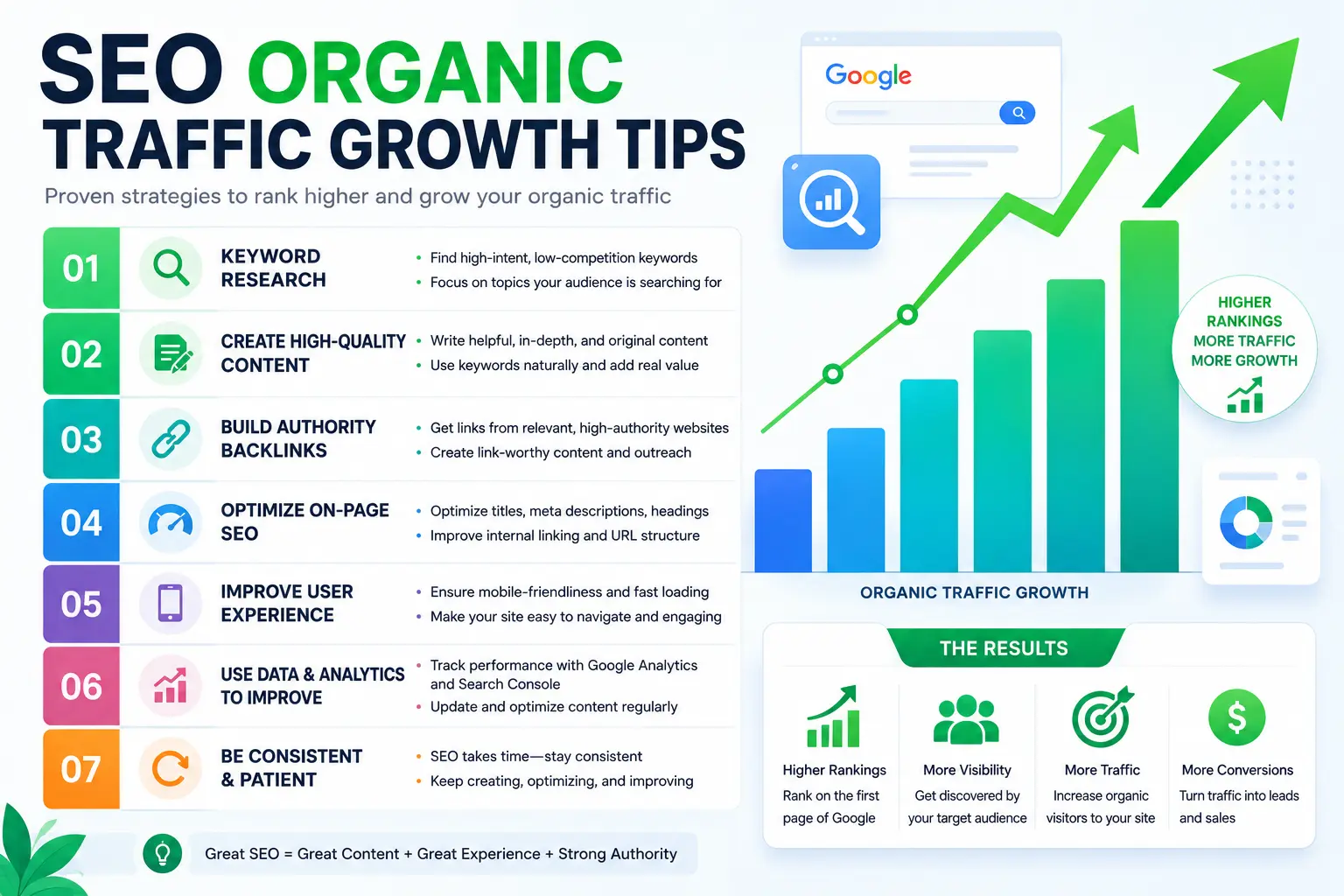
Growing a website through SEO is no longer about chasing keywords or publishing random blog posts. Today, real growth comes from strategy—understanding search intent, building authority, and improving user experience in a structured way.
If your goal is to increase traffic, rank higher on Google, and turn visitors into customers, these SEO website growth strategies will help you build a strong and scalable foundation.
1. Start with Search Intent, Not Just Keywords
One of the biggest mistakes websites make is targeting keywords without understanding what users actually want.
Search intent generally falls into four categories:
- Informational (learning something)
- Navigational (finding a specific site)
- Commercial (comparing options)
- Transactional (ready to buy)
For example, someone searching “best SEO tools” is comparing options, not looking for a definition. Your content should match that expectation, not just repeat the keyword.
When your content aligns with intent, rankings improve naturally because users stay longer and engage more.
2. Build Topic Clusters for Authority
Instead of publishing isolated blog posts, group your content into topic clusters.
A topic cluster includes:
- One pillar page (main topic overview)
- Multiple supporting articles (subtopics)
- Internal links connecting them
Example:
- Pillar: SEO Website Growth Guide
- Supporting posts: keyword research, technical SEO, link building, on-page SEO
This structure helps search engines understand your website’s depth and relevance, improving your overall authority in the niche.
3. Optimize Technical SEO for Performance
Even great content won’t rank if your site has technical issues.
Focus on:
- Fast loading speed
- Mobile-friendly design
- Clean URL structure
- Proper indexing and crawlability
- Fixing broken links
Tools like Google Search Console help you identify indexing issues, search performance gaps, and technical errors that can block growth.
A technically healthy site gives search engines a clear path to understand and rank your content.
4. Create Content That Actually Solves Problems
High-ranking content isn’t just long—it’s useful.
To improve your content quality:
- Answer real user questions clearly
- Use examples instead of theory
- Keep paragraphs short and readable
- Add comparisons, steps, or frameworks
Avoid writing just for keywords. Write for clarity and solutions.
Google rewards pages that satisfy users, not pages that simply repeat phrases.
5. Strengthen Internal Linking Structure
Internal links are one of the most underrated SEO growth tools.
They help:
- Distribute authority across pages
- Guide users to related content
- Improve crawling and indexing
A good rule:
Every blog post should link to at least 2–4 related pages on your site.
Think of internal linking as building roads inside your website—without them, users and search engines get lost.
6. Earn High-Quality Backlinks Naturally
Backlinks still matter, but quality beats quantity.
Focus on:
- Guest posting on relevant websites
- Creating shareable content (guides, data, insights)
- Digital PR and outreach
- Fixing broken links on other sites and offering your content as a replacement
Avoid spammy or paid link schemes. They may give short-term results but harm long-term growth.
7. Improve User Experience (UX) Signals
Google increasingly measures how users interact with your site.
Key UX signals include:
- Time on page
- Bounce rate
- Click-through rate
- Mobile usability
To improve UX:
- Use clean design and readable fonts
- Break content into sections with headings
- Add visuals or examples
- Reduce intrusive ads or popups
Better user experience leads directly to better rankings.
8. Refresh and Update Old Content
Old content can still drive traffic—if you keep it updated.
Regularly:
- Update outdated statistics
- Add new insights or examples
- Improve formatting and structure
- Target new related keywords
Content refresh is often faster and more effective than publishing new posts from scratch.
Frequently Asked Questions
1. How long does SEO take to grow a website?
SEO usually takes 3–6 months to show strong results, depending on competition and consistency.
2. Do I need backlinks for SEO growth?
Yes, backlinks help build authority, but they must come from relevant, trustworthy sources.
3. What is the most important SEO strategy?
There is no single strategy. The best results come from combining content quality, technical SEO, and authority building.
4. Can small websites compete with big sites?
Yes—by targeting niche topics, long-tail keywords, and producing highly focused content.
Conclusion
SEO website growth is not about shortcuts—it’s about building a system that consistently attracts, engages, and converts users. When you align content with search intent, strengthen technical SEO, and build authority through structured content and links, growth becomes predictable and scalable.
