
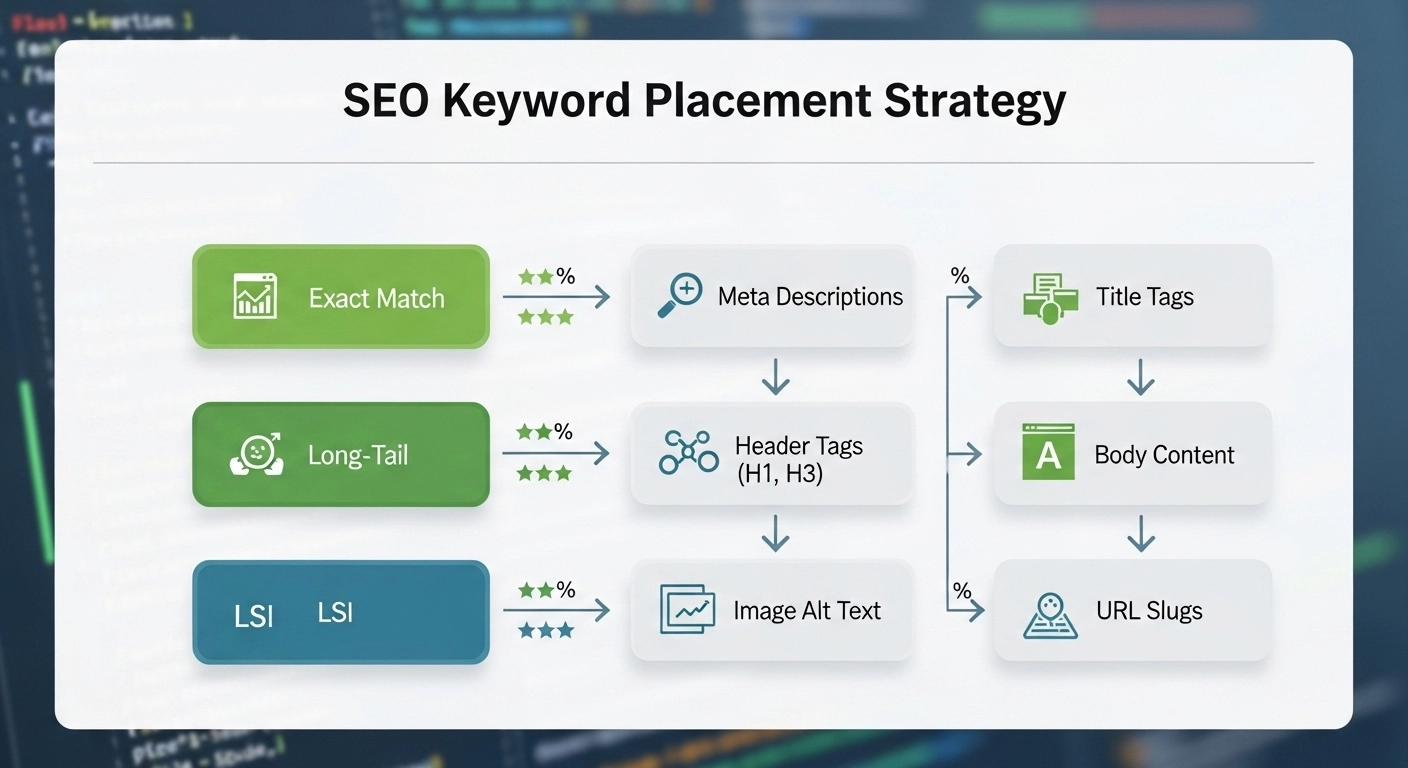
Getting traffic from Google isn’t just about choosing the right keywords anymore. The real difference between pages that rank and pages that get ignored often comes down to where and how you place those keywords.
That’s exactly what a strong SEO keyword placement strategy focuses on—putting your keywords in the right spots so search engines understand your content, and users enjoy reading it.
Let’s break it down in a practical, no-fluff way.
What Is an SEO Keyword Placement Strategy?
An SEO keyword placement strategy is the planned way you distribute your target keywords and related terms throughout your content.
Instead of stuffing keywords randomly, you place them in specific areas that matter most for:
- Search engine understanding
- User readability
- Ranking signals
- Click-through optimization
In simple terms: it’s not just what keywords you use, but where you use them.
Why Keyword Placement Still Matters in SEO
Even though Google is smarter than ever, keyword placement still plays a key role in helping search engines understand context.
Here’s why it matters:
- It helps Google identify your page topic quickly
- It improves relevance for search queries
- It supports better on-page SEO structure
- It increases chances of ranking for multiple related terms
But the goal is not repetition—it’s strategic distribution.
Best Places to Use Keywords for Maximum Impact
A strong SEO keyword placement strategy focuses on high-impact locations first.
1. Title Tag (Most Important)
Your title tag is one of the strongest ranking signals.
✔ Place your main keyword near the beginning if possible.
Example:
- Good: SEO Keyword Placement Strategy: Complete Guide for Better Rankings
- Weak: A Complete Guide to Improving Your SEO and Keyword Strategy
2. Introduction (First 100 Words)
Google pays close attention to your opening paragraph.
✔ Mention your main keyword once naturally in the intro.
This confirms your topic immediately.
3. Headings (H2 and H3)
Headings help structure your content for both users and search engines.
✔ Use variations of your keyword in at least 1–2 headings.
Example H2:
- How an SEO Keyword Placement Strategy Improves Rankings
Avoid forcing exact match keywords in every heading.
4. URL Structure
Short, clean URLs rank better and improve click-through rates.
✔ Include the main keyword in a simplified form.
Example:
- /seo-keyword-placement-strategy
5. Meta Description
While not a direct ranking factor, it affects clicks.
✔ Add your keyword naturally and focus on user benefit.
6. First and Last Paragraph
Search engines often evaluate content framing.
✔ Mention your keyword or close variation once near the end for reinforcement.
7. Image Alt Text
Images help SEO when properly optimized.
✔ Use descriptive alt text with related keywords.
Example:
“SEO keyword placement strategy diagram showing keyword distribution in blog content”
8. Internal Links
Internal linking strengthens site structure.
✔ Use keyword-rich but natural anchor text.
Instead of:
- “click here”
Use:
- “its guide”
Smart Keyword Distribution (Not Stuffing)
A modern SEO keyword placement strategy is about balance.
Here’s a natural approach:
- Primary keyword: 1–2% density max
- Secondary keywords: sprinkled naturally
- LSI terms: used for context, not repetition
Related semantic terms to include:
- on-page SEO
- keyword optimization
- content structure
- search intent
- organic ranking
- topical relevance
This helps Google understand your content more deeply without over-optimization.
Common Keyword Placement Mistakes to Avoid
Even good content fails when keyword placement is done wrong.
Avoid these mistakes:
1. Keyword stuffing
Repeating the same phrase too often makes content unreadable.
2. Ignoring headings
Leaving keywords only in paragraphs weakens structure.
3. Forcing keywords unnaturally
If it doesn’t sound human, it won’t perform well.
4. Over-optimizing every section
Google prefers natural variation over repetition.
Simple SEO Keyword Placement Strategy Framework
Here’s a practical workflow you can follow every time:
- Place keyword in title
- Add it in the first paragraph
- Use it in at least one heading
- Include variations throughout content
- Optimize images + meta description
- Add internal links with natural anchors
- Reinforce once near the conclusion
This keeps your SEO clean, structured, and effective.
FAQ: SEO Keyword Placement Strategy
1. How many times should I use a keyword in a blog post?
There’s no fixed number. Focus on natural usage instead of density. Typically, 1–2% is safe for most content.
2. Where is the most important place to add keywords?
The most important spots are the title tag, first paragraph, and H2 headings.
3. Can I rank without exact keyword placement?
Yes, but proper placement improves clarity and helps Google understand your topic faster.
4. Should I use exact match keywords everywhere?
No. Use variations and related terms to keep content natural and readable.
5. Does keyword placement still matter in 2026 SEO?
Yes, but it works best when combined with high-quality content and strong search intent matching.
Conclusion
A strong SEO keyword placement strategy is not about repeating keywords—it’s about using them intelligently across your content so both users and search engines clearly understand your topic.
When done right, it improves rankings, boosts engagement, and strengthens your overall SEO structure without sacrificing readability.
