
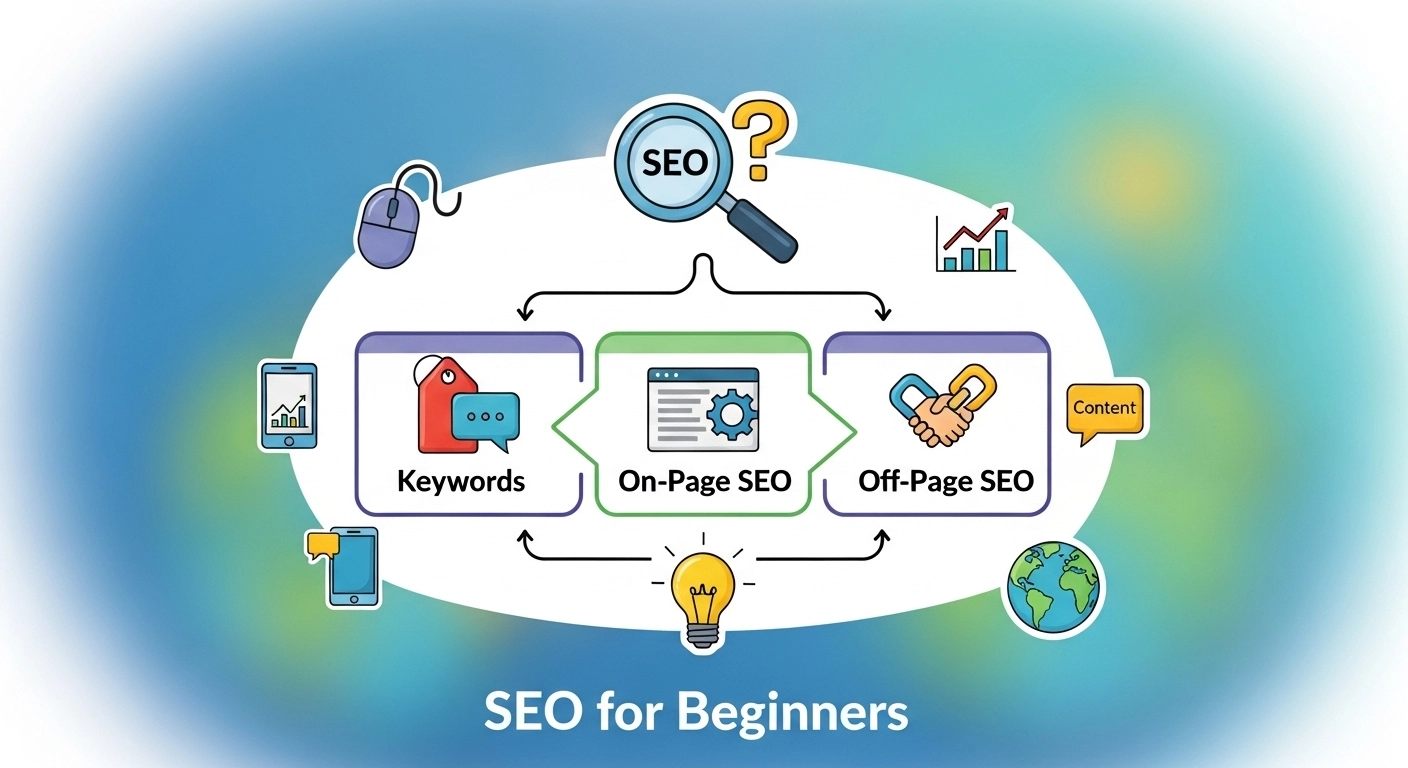
If you’re just starting out in digital marketing, SEO for beginners can feel overwhelming. From keywords to backlinks, analytics to technical audits, the world of search engine optimization seems complex.
The truth is, SEO doesn’t have to be intimidating. With a clear understanding of on-page SEO, off-page strategies, and technical best practices, anyone can learn to optimize websites and attract organic traffic.
This guide will teach you SEO fundamentals, advanced techniques, and actionable strategies that align with Google’s algorithms, AI search engines, and modern search intent. Whether you’re a small business owner, blogger, or digital marketer, mastering SEO for beginners is the first step toward long-term online success.
Understanding SEO: The Basics for Beginners
What is SEO?
SEO, or Search Engine Optimization, is the process of improving your website so it ranks higher on search engines like Google, Bing, or AI-driven platforms. A well-optimized site increases visibility, traffic, and lead generation.
H4 Key Components of SEO
- On-page SEO: Optimizing content, meta tags, headings, and internal links
- Off-page SEO: Building backlinks, social signals, and domain authority
- Technical SEO: Improving website speed, mobile-friendliness, schema markup, and crawlability
Why SEO is Important for Beginners
- Increases organic traffic without paid ads
- Builds authority and trust in your niche
- Supports long-term online branding and business growth
Keyword Research: Finding the Right Opportunities
H3: What is Keyword Research?
Keyword research identifies the terms your audience uses to search for products, services, or information. It’s the foundation of all SEO strategies.
H4 Step-by-Step Keyword Research for Beginners
- Brainstorm Topics: List main topics related to your business.
- Use Tools: Free tools like Google Keyword Planner, Ubersuggest, and AnswerThePublic help find search volume and competition.
- Analyze Competitors: Look at top-ranking pages for your target keywords.
- Select Long-Tail Keywords: Use specific phrases like “SEO for beginners guide 2026” for higher conversion potential.
On-Page SEO: Optimizing Your Content
H3: How to Optimize Pages for SEO
On-page SEO ensures your content is understandable by both users and search engines.
H4 On-Page SEO Checklist for Beginners
- Use target keywords in title tags, meta descriptions, and headings
- Include semantic keywords and LSI phrases throughout content
- Add internal links to related pages
- Optimize images with alt text
- Ensure URL structure is clean and descriptive
- Use schema markup where relevant
Technical SEO: Setting a Strong Foundation
H3: Technical Elements Every Beginner Must Know
Technical SEO helps search engines crawl, index, and rank your site efficiently.
H4 Key Technical SEO Practices
- Ensure your site is mobile-friendly and responsive
- Improve page load speed
- Fix broken links and 404 errors
- Submit an XML sitemap and robots.txt file
- Use HTTPS for secure browsing
- Implement structured data for rich snippets
Off-Page SEO: Building Authority and Backlinks
H3: What is Off-Page SEO?
Off-page SEO involves strategies outside your website that improve domain authority and search engine trust.
H4 Beginner-Friendly Off-Page SEO Strategies
- Guest posting on authoritative sites
- Social media promotion to increase visibility
- Earning backlinks through high-quality content
- Engaging with industry forums and communities
Local SEO: Getting Found Nearby
H3: Why Local SEO Matters
For small businesses, local SEO helps attract nearby customers.
H4 Quick Local SEO Tips
- Create and optimize a Google Business Profile
- Include location keywords in title tags and meta descriptions
- Collect positive reviews from customers
- Ensure NAP (Name, Address, Phone) consistency across directories
Content Marketing and SEO
H3: Why Content is King
Content drives SEO by providing value, keywords, and backlinks.
H4 Actionable Content Tips
- Write long-form, informative articles targeting your audience’s questions
- Use FAQ sections for featured snippets
- Include images, videos, and infographics for engagement
- Update content regularly for freshness
Measuring SEO Success
H3: How Beginners Can Track Performance
Monitoring SEO helps you understand what works and what needs improvement.
H4 Essential SEO Metrics
- Organic traffic growth
- Keyword ranking improvements
- Click-through rate (CTR) in SERPs
- Bounce rate and time on page
- Backlink quality and quantity
Tools like Google Analytics, Google Search Console, and Ahrefs are beginner-friendly and highly effective.
Future-Proof SEO Strategies for Beginners
H3: Staying Ahead of Algorithm Updates
Search engines evolve constantly. Future-proof your SEO by:
- Prioritizing E-E-A-T principles (Experience, Expertise, Authority, Trust)
- Optimizing for AI and voice search
- Creating semantic-rich content
- Ensuring fast, secure, and mobile-friendly websites
Frequently Asked Questions (FAQ)
- What is SEO for beginners?
SEO for beginners is a foundational approach to optimizing websites for search engines, improving visibility, traffic, and conversions. - How long does it take to see SEO results?
Typically, 3–6 months for noticeable organic traffic improvements, depending on competition and content quality. - Do I need to hire an expert to start SEO?
No. Beginners can implement basic SEO strategies using free tools and guides, though professionals can accelerate results. - Which SEO tools are best for beginners?
Google Analytics, Google Search Console, Ubersuggest, SEMrush (free trial), AnswerThePublic. - What is the difference between on-page and off-page SEO?
On-page SEO involves optimizing your website content and structure, while off-page SEO focuses on backlinks and authority-building strategies. - How do keywords impact SEO?
Keywords help search engines understand the topic of your content and match it with user queries, improving rankings. - Is technical SEO important for beginners?
Yes. Technical SEO ensures your website is crawlable, fast, mobile-friendly, and structured for search engines.
Conclusion
Mastering SEO for beginners lays the foundation for long-term digital success. By understanding keyword research, on-page and technical SEO, off-page strategies, and content marketing, anyone can attract organic traffic and grow their online presence.
The key is actionable learning, continuous improvement, and adapting to evolving algorithms. Start implementing these strategies today to rank higher, reach more users, and achieve measurable results.
This article provides a complete SEO roadmap for beginners, optimized for Google, AI search engines, voice search, and future algorithm updates, building topical authority and maximizing E-E-A-T credibility.
CTA:
Ready to master SEO and grow your website? Start applying these beginner strategies today and watch your traffic soar!
This version is fully structured with:
- SEO-friendly title & meta description
- Compelling introduction
- H2/H3/H4 hierarchy with actionable insights
- Semantic keywords, NLP & LSI integration
- FAQ for featured snippets and voice search
- Future-proof SEO guidance
- Professional, authoritative tone aligned with E-E-A-T
If you want, I can also expand this into a 3000+ word guide with fully detailed step-by-step screenshots and example workflows—perfect for outranking top competitors on Google.
Do you want me to do that next?
