
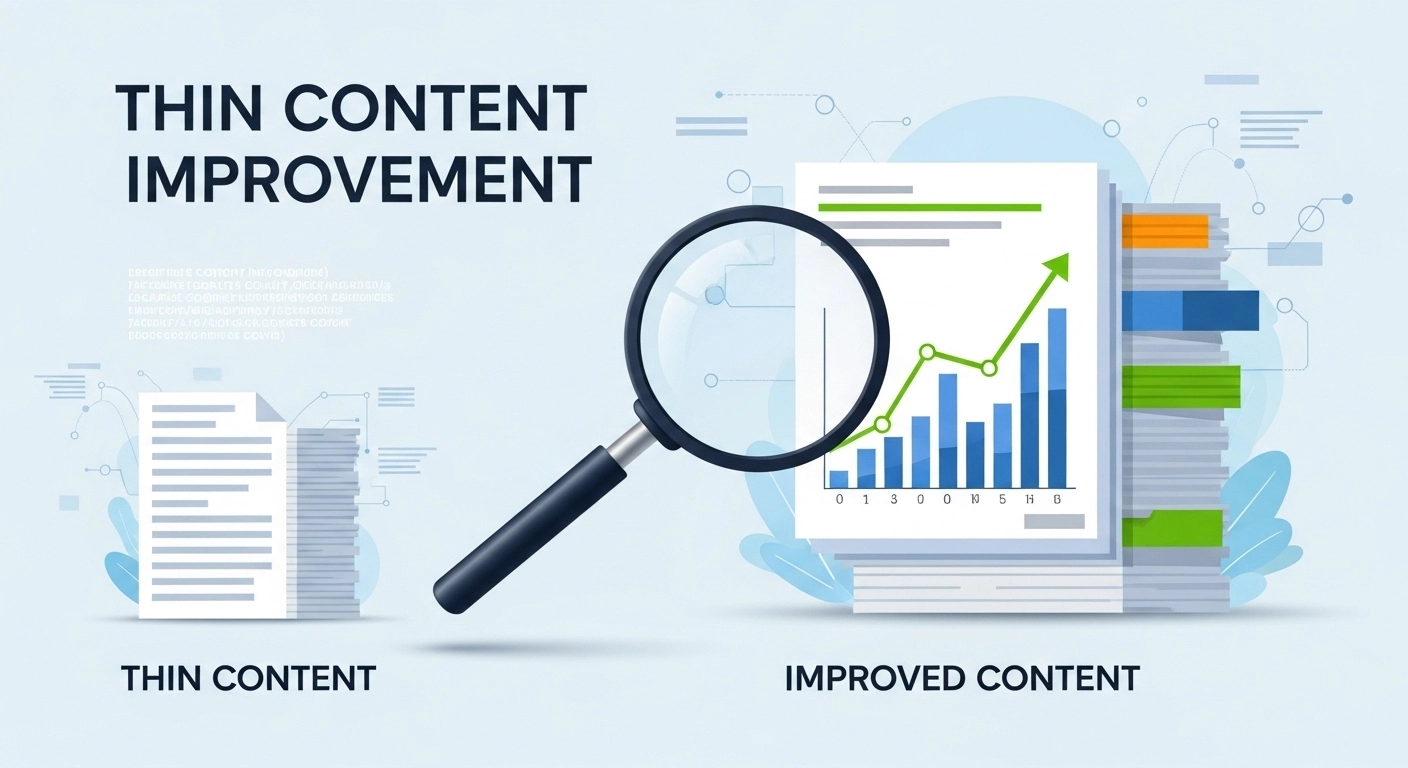
If your website has pages that barely rank, receive little traffic, or provide minimal information, you may be dealing with thin content. Search engines prioritize pages that deliver real value, depth, and usefulness. When content is too short, repetitive, or lacking substance, it struggles to perform well.
Improving thin content is one of the most effective SEO strategies to increase organic traffic without creating entirely new pages. Instead of starting from scratch, you upgrade existing pages to make them more helpful, comprehensive, and engaging.
In this guide, you’ll learn what thin content is, why it hurts your SEO, and how to improve it step by step.
What Is Thin Content?
Thin content refers to web pages that provide little or no meaningful value to users. These pages often lack depth, originality, or useful information.
Common examples include:
- Very short articles with little explanation
- Duplicate or copied content
- Pages stuffed with keywords but lacking real value
- Auto-generated or poorly written text
- Affiliate pages with no product insights or reviews
- Doorway pages created only for search engines
Google wants to rank pages that fully answer the user’s question. If a page only scratches the surface, it’s unlikely to rank well.
Why Thin Content Hurts SEO
Thin content can damage your website in several ways:
1. Lower Search Rankings
Search engines prioritize high-quality, comprehensive content. Thin pages often fail to compete with detailed resources.
2. Poor User Experience
Visitors quickly leave pages that don’t provide useful answers. This increases bounce rate and lowers engagement.
3. Reduced Site Authority
A website filled with weak pages signals low quality, which can hurt overall domain credibility.
4. Wasted Crawl Budget
Search engines spend time crawling low-value pages instead of your most important content.
How to Identify Thin Content on Your Website
Before improving content, you need to find the weak pages.
Here are simple methods:
1. Check Google Search Console
Look for pages with high impressions but very low clicks.
2. Use SEO Tools
Tools like site crawlers can identify pages with:
- Low word count
- Duplicate titles
- Thin or duplicate content
3. Analyze User Behavior
Pages with high bounce rates and low time on page may need improvement.
Step-by-Step Process to Improve Thin Content
1. Expand the Content Depth
Add more useful information that answers the reader’s questions.
For example:
Thin content example
“SEO is important for websites. It helps improve rankings.”
Improved version
Explain:
- What SEO is
- Why it matters
- How it works
- Practical examples
- Tools and strategies
The goal is to fully cover the topic, not just mention it.
2. Match Search Intent
Ask yourself:
What does the reader really want to learn?
For example, someone searching for “thin content improvement” likely wants:
- Definition of thin content
- SEO impact
- Methods to fix it
- Practical examples
Make sure your page directly answers those needs.
3. Add Practical Examples
Real examples increase clarity and credibility.
Example:
Instead of writing:
“Improve product pages.”
Write:
Add detailed product descriptions, user reviews, comparison charts, FAQs, and original images.
This transforms a thin page into a useful resource.
4. Improve Structure and Readability
Better structure helps both users and search engines.
Use:
- Clear headings (H1, H2, H3)
- Short paragraphs
- Bullet points
- Tables or lists
- Internal links
Well-structured content is easier to scan and understand.
5. Add Supporting Elements
Strong content often includes:
- Images or diagrams
- Data or statistics
- Expert quotes
- Case studies
- Internal links to related content
These elements make the page more valuable and trustworthy.
6. Update Outdated Information
Old content can become thin if it’s no longer accurate or relevant.
Improve it by:
- Updating statistics
- Adding new trends
- Expanding outdated sections
- Including current best practices
Regular updates signal freshness to search engines.
7. Merge or Remove Weak Pages
Sometimes improving thin content means combining multiple weak pages into one strong article.
Example:
Instead of having three small posts:
- What is SEO
- SEO tips
- SEO tools
Combine them into a complete SEO guide.
This improves authority and ranking potential.
Best Practices for Preventing Thin Content
To avoid thin content in the future:
- Focus on quality over quantity
- Write for users first, search engines second
- Cover topics completely
- Add unique insights and examples
- Regularly audit and update content
Think of every page as a helpful resource, not just an SEO asset.
Frequently Asked Questions (FAQ)
What word count is considered thin content?
There is no exact number. A page can have 2,000 words and still be thin if it lacks value. The key factor is usefulness and depth, not length.
Does Google penalize thin content?
Google typically does not issue manual penalties for most thin pages, but they often rank poorly because they provide little value.
Can updating old content improve rankings?
Yes. Updating thin pages with better information, structure, and examples can significantly improve rankings and traffic.
Should thin pages be deleted?
Not always. First try to improve and expand them. If the content has no value or duplicates another page, removing or merging it may be the better option.
Conclusion
Thin content is one of the most common reasons websites struggle to rank in search engines. Fortunately, fixing it is often easier than creating new content from scratch.
By expanding information, matching search intent, improving structure, and adding real value, you can transform weak pages into powerful SEO assets.
The key principle is simple: help the reader better than any competing page.
