
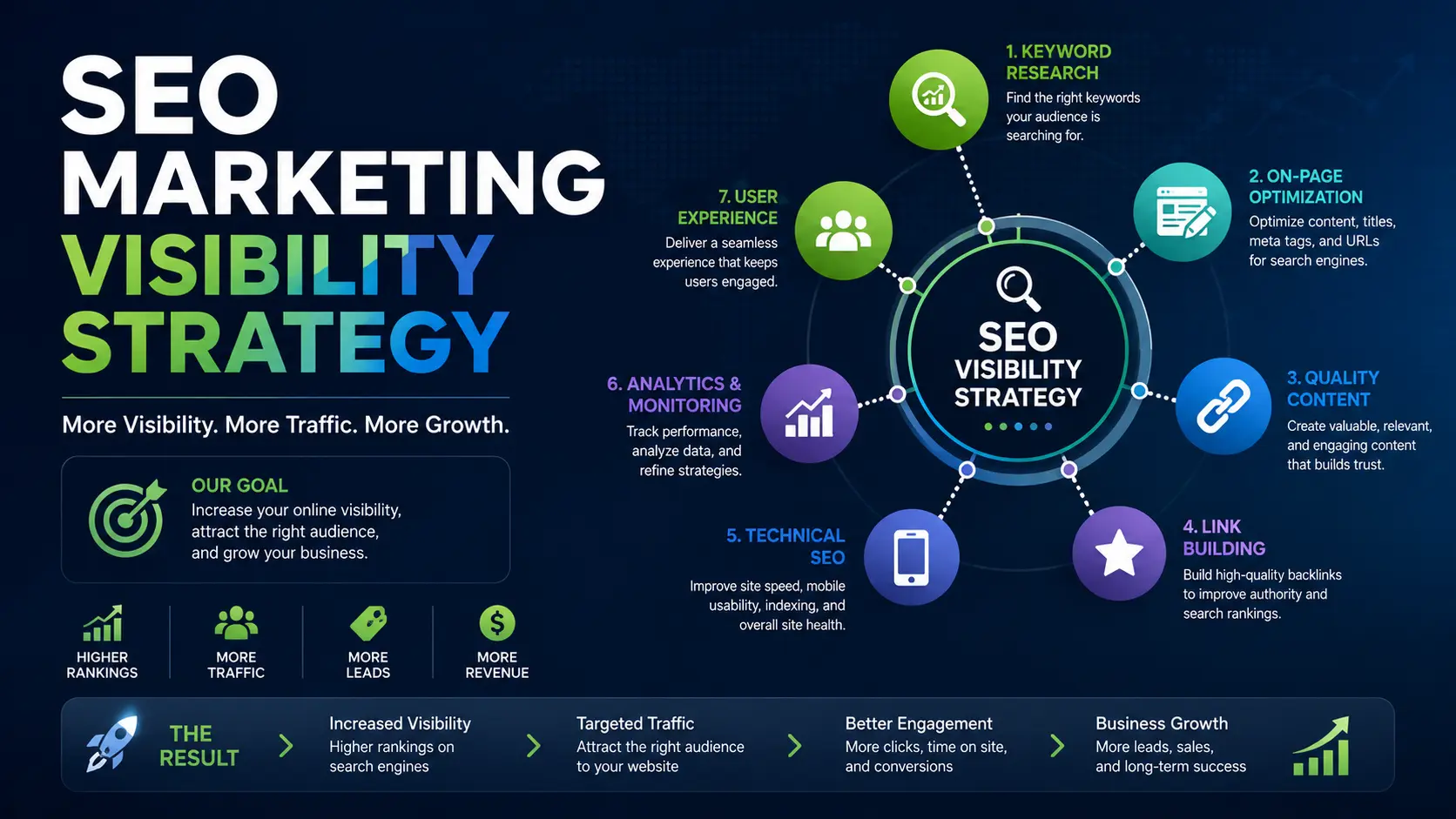
If your website isn’t showing up where your audience is searching, it’s invisible—no matter how good your product or content is. A strong SEO marketing visibility strategy fixes that. It’s not just about rankings; it’s about showing up in the right places, at the right time, with the right message.
This guide walks you through a clear, actionable approach to boost your search visibility and turn it into real traffic and growth.
What Is an SEO Marketing Visibility Strategy?
An SEO marketing visibility strategy is a structured plan to increase how often and how prominently your brand appears in search results—across Google, images, videos, maps, and even featured snippets.
It combines:
- Keyword targeting
- Content strategy
- Technical SEO
- Authority building
- User experience optimization
The goal is simple: be found by people actively searching for what you offer.
Why Visibility Matters More Than Rankings Alone
Ranking #1 is great—but not if no one clicks.
Modern SEO is about:
- Search intent alignment (matching what users actually want)
- SERP presence (featured snippets, FAQs, rich results)
- Click-through rate (CTR) optimization
Example:
A page ranking #3 with a strong title and meta description can outperform a weak #1 listing.
Step-by-Step SEO Visibility Strategy
1. Start with Search Intent (Not Just Keywords)
Forget chasing random keywords. Focus on intent clusters:
- Informational (e.g., “what is SEO visibility”)
- Navigational (brand-related searches)
- Transactional (buy, hire, subscribe)
Tip:
Search your target keyword and analyze the top 10 results:
- Are they blog posts, product pages, or guides?
- Match that format exactly.
2. Build a Topic Authority Structure
Google rewards websites that cover a topic deeply.
Use the pillar + cluster model:
- Pillar page: “SEO Marketing Visibility Strategy”
- Supporting posts:
- Technical SEO checklist
- On-page SEO optimization
- Link building strategies
- Content marketing for SEO
Interlink them naturally to signal expertise.
3. Optimize for On-Page SEO (the Right Way)
Focus on clarity and usefulness, not keyword stuffing.
Key elements:
- Title tag (clear + compelling)
- Meta description (benefit-driven)
- H1, H2 structure (logical flow)
- Internal links (connect related content)
- Image alt text (for accessibility + SEO)
Example:
Instead of
“SEO visibility strategy best SEO visibility strategy”
Use
“SEO Visibility Strategy: How to Increase Traffic and Rankings”
4. Strengthen Technical SEO Foundations
Even great content won’t rank if your site has technical issues.
Check:
- Page speed (Core Web Vitals)
- Mobile usability
- Crawlability (no broken links, clean structure)
- Indexing (important pages included)
Quick win:
Fix slow-loading pages—this alone can boost rankings and engagement.
5. Create Content That Earns Clicks
Visibility isn’t just about appearing—it’s about attracting attention.
Write content that:
- Solves a real problem
- Uses simple language
- Includes examples and actionable steps
Add:
- Bullet points for clarity
- Short paragraphs
- Strong subheadings
6. Capture SERP Features
Go beyond standard rankings.
Optimize for:
- Featured snippets (answer questions clearly)
- FAQ sections
- Image search
- Video content
Example:
Add a concise 40–60 word answer under a question heading to win snippets.
7. Build Authority with Backlinks
Google trusts websites that others reference.
Focus on:
- Guest posting
- Digital PR
- High-quality directories
- Linkable assets (guides, tools, data)
Rule: Quality over quantity.
8. Track Visibility Metrics (Not Just Traffic)
Use tools like Google Search Console to monitor:
- Impressions (how often you appear)
- Average position
- CTR (click-through rate)
If impressions are high but clicks are low → improve titles and meta descriptions.
Real-World Example
Let’s say you run a digital marketing site.
Instead of targeting just:
- “SEO services”
You build a visibility strategy:
- “SEO for small businesses”
- “How to improve website visibility”
- “Technical SEO checklist”
You interlink them, optimize intent, and improve page speed.
Result:
- More keywords ranking
- Higher impressions
- Consistent traffic growth
Common Mistakes to Avoid
- Targeting keywords without understanding intent
- Ignoring technical SEO
- Publishing thin or duplicate content
- Not updating old content
- Chasing backlinks without relevance
Simple FAQ
What is SEO visibility?
SEO visibility measures how often your website appears in search results for relevant queries.
How long does it take to improve visibility?
Typically 3–6 months, depending on competition and consistency.
Is content or backlinks more important?
Both matter. Content builds relevance; backlinks build authority.
Can I improve visibility without backlinks?
Yes, but growth will be slower in competitive niches.
Final Thoughts
A successful SEO marketing visibility strategy isn’t about shortcuts—it’s about consistency, clarity, and smart optimization.
Focus on:
- Matching search intent
- Building topical authority
- Improving technical performance
- Creating content people actually want
Do this well, and your visibility—and traffic—will grow naturally.
