
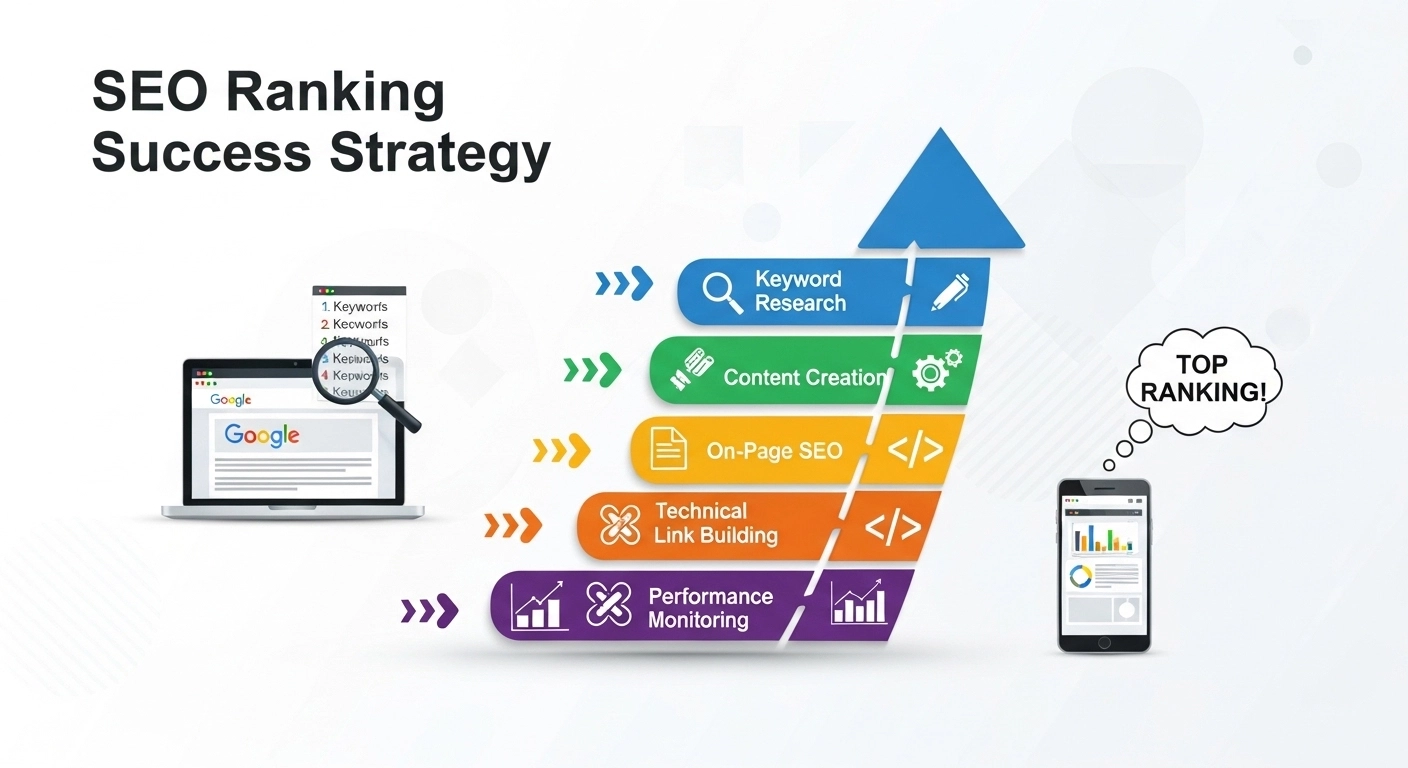
If you want consistent organic traffic—not spikes that disappear overnight—you need more than basic SEO tips. You need a clear, repeatable SEO ranking success strategy built on search intent, quality content, and technical precision.
This guide walks you through exactly how to build that system.
What “SEO Ranking Success” Really Means
Ranking success isn’t just hitting page one. It means:
- Ranking for keywords that drive real traffic and conversions
- Staying ranked despite algorithm updates
- Building topical authority in your niche
- Turning organic visitors into leads or customers
In short: visibility + relevance + trust.
Step 1: Start With Search Intent (Not Just Keywords)
Most SEO fails because people chase keywords instead of understanding why users search.
The 4 Types of Search Intent:
- Informational – “how to improve SEO”
- Navigational – brand searches
- Commercial – “best SEO tools”
- Transactional – “buy SEO services”
Strategy:
Before writing anything, ask:
What does the user actually want to achieve?
Example:
Keyword: “SEO ranking success strategy”
Intent: Learn a complete, actionable system (like this guide)
👉 If your content doesn’t match intent, it won’t rank—no matter how optimized it is.
Step 2: Build a Smart Keyword Strategy
Forget random keyword lists. Focus on structured keyword mapping.
Use This Approach:
- Primary keyword → Main topic
- Secondary keywords → Variations
- Long-tail keywords → Specific queries
- Semantic keywords → Related concepts
Example Cluster:
- SEO ranking success strategy
- how to rank higher on Google
- SEO strategy for beginners
- improve website rankings fast
👉 This helps search engines understand your topic depth.
Step 3: Create Content That Deserves to Rank
Google rewards content that is:
- Helpful
- Clear
- Original
- Comprehensive
Winning Content Formula:
1. Strong headline
- Clear benefit
- Matches search intent
2. Easy readability
- Short paragraphs
- Simple language
- Logical flow
3. Real value
- Examples
- Actionable steps
- Practical tips
4. Depth without fluff
- Cover the topic fully
- Avoid repetition
Step 4: Optimize On-Page SEO Like a Pro
Even great content needs proper optimization.
Key Elements:
Title Tag
- Include main keyword
- Keep it natural and clickable
Meta Description
- Clear summary + CTA
- Improve click-through rate
Headings (H1–H3)
- Structure content
- Include variations of keywords
URL
- Short and clean
Example:/seo-ranking-success-strategy
Internal Linking
- Link to related content
- Build topic authority
Step 5: Master Technical SEO Basics
Technical SEO ensures your site is easy for search engines to crawl and index.
Focus On:
- Fast loading speed
- Mobile-friendly design
- Clean site structure
- XML sitemap
- No broken links
👉 If your site is slow or hard to navigate, rankings will suffer—no matter how good your content is.
Step 6: Build Authority With Backlinks
Backlinks are still one of the strongest ranking factors.
How to Get Them:
- Guest posting
- High-quality blog content
- Data-driven articles
- Outreach to relevant sites
Pro Tip:
Focus on quality over quantity. One strong backlink is better than 50 weak ones.
Step 7: Strengthen Topical Authority
Instead of writing random posts, build content clusters.
Example Structure:
- Pillar Page: SEO Strategy Guide
- Supporting Articles:
- Keyword research guide
- On-page SEO checklist
- Technical SEO basics
- Link building strategies
👉 This signals expertise and improves rankings across multiple keywords.
Step 8: Track, Test, and Improve
SEO is not “set and forget.”
Monitor:
- Rankings
- Organic traffic
- Click-through rate (CTR)
- Bounce rate
Improve:
- Update old content
- Optimize underperforming pages
- Add new internal links
👉 Small improvements often lead to big ranking gains.
Common Mistakes to Avoid
- Ignoring search intent
- Keyword stuffing
- Publishing thin content
- Not updating old articles
- Weak internal linking
Fixing these alone can significantly improve your rankings.
FAQ: SEO Ranking Success Strategy
How long does SEO take to work?
Typically 3–6 months, but competitive niches may take longer.
Is content or backlinks more important?
Both matter, but content comes first. Without quality content, backlinks won’t help much.
How often should I update content?
Every 3–6 months for important pages.
Can I rank without backlinks?
Yes, but it’s harder in competitive niches.
Final Thoughts: Build a System, Not Just Pages
SEO success isn’t about tricks—it’s about consistency.
If you:
- Understand search intent
- Create valuable content
- Optimize properly
- Build authority
You’ll see steady, long-term growth.
