
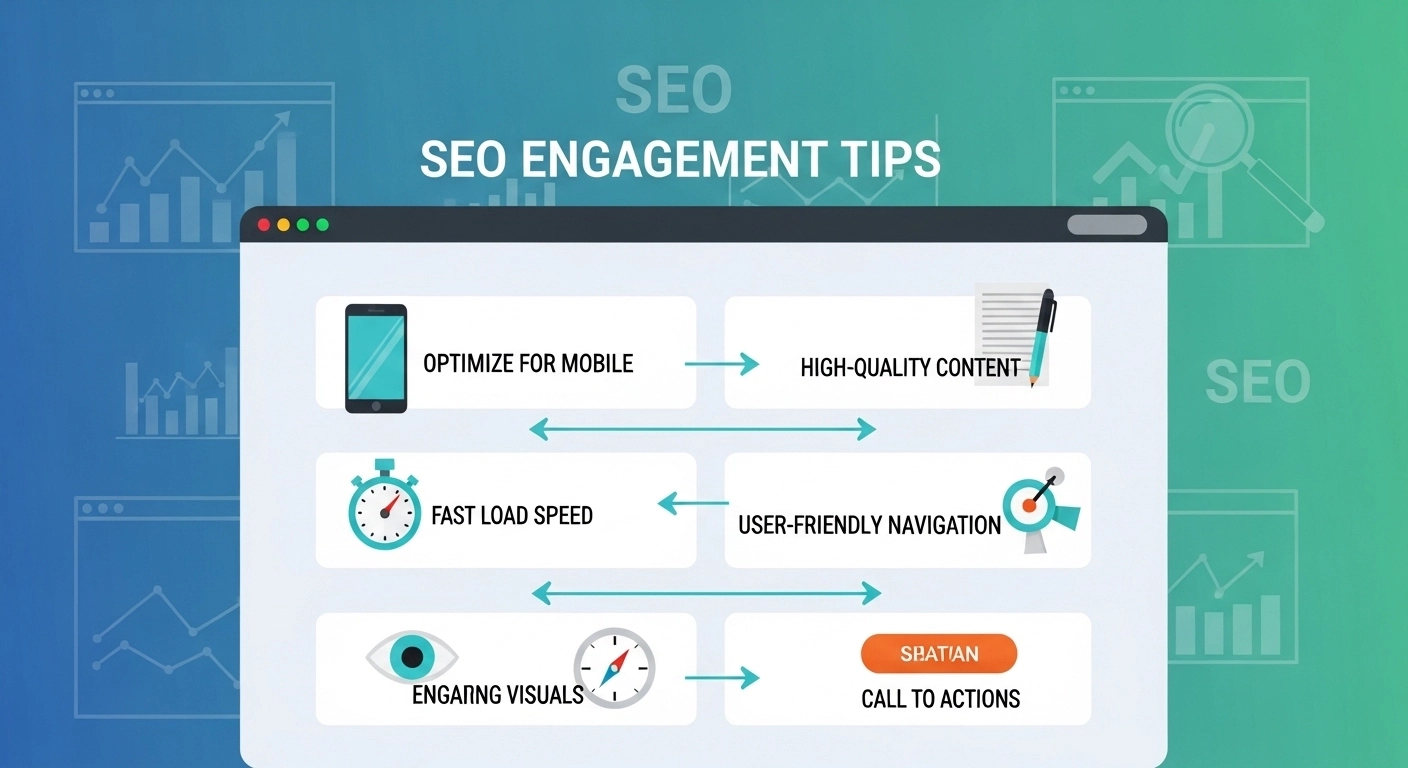
If people land on your website and leave within seconds, your SEO efforts won’t go far—no matter how good your keywords are. Search engines pay close attention to how users interact with your site. That means engagement isn’t just a “nice to have”—it’s a ranking factor.
In this guide, you’ll learn practical SEO website engagement tips that help you keep visitors longer, reduce bounce rate, and improve your search visibility.
Why Website Engagement Matters for SEO
Search engines like Google want to show users results that actually solve their problems. If visitors click your site and quickly return to search results, it signals low value.
On the other hand, strong engagement tells search engines:
- Your content is useful
- Your website is easy to navigate
- Users are finding what they need
Key engagement signals include:
- Time on page
- Bounce rate
- Pages per session
- Scroll depth
- Click-through behavior
Improving these signals directly supports better rankings over time.
1. Improve User Experience (UX) First
A clean, simple user experience is the foundation of engagement.
Ask yourself:
- Can visitors find information in 3 seconds?
- Is the layout clean or cluttered?
- Is navigation easy on all devices?
Practical improvements:
- Use a clear menu structure
- Add a search bar for large websites
- Keep design consistent across pages
- Avoid pop-ups that block content
A smooth UX reduces frustration and naturally increases time spent on your site.
2. Create Content That Actually Solves Problems
Engagement starts with content quality. If your content doesn’t answer real questions, users won’t stay.
Focus on:
- Clear answers instead of vague explanations
- Step-by-step guides
- Real-world examples
- Updated and accurate information
For example, instead of writing:
“SEO is important for websites”
Write:
“SEO helps your website appear in Google when people search for services like yours, bringing free and targeted traffic.”
Helpful content keeps users reading—and returning.
3. Use Strong Internal Linking Strategy
Internal links guide users through your website and increase page views per session.
Good internal linking:
- Connects related blog posts
- Points to service or product pages
- Helps users discover more value
Example:
If you write about SEO engagement tips, link to related topics like:
- On-page SEO guide
- Content optimization strategies
- Technical SEO checklist
This keeps users moving deeper into your site instead of leaving after one page.
4. Speed Up Your Website
Slow websites kill engagement instantly. Most users leave if a page takes more than a few seconds to load.
To improve speed:
- Compress images before uploading
- Use caching tools
- Reduce unnecessary plugins
- Choose a fast hosting provider
You can test performance using tools like Google PageSpeed Insights.
Even a one-second improvement in load time can significantly increase engagement.
5. Make Your Website Mobile-Friendly
More than half of web traffic comes from mobile devices. If your site isn’t mobile-friendly, engagement will suffer.
Mobile optimization tips:
- Use responsive design
- Keep fonts readable without zooming
- Ensure buttons are easy to tap
- Avoid horizontal scrolling
A mobile-first experience is no longer optional—it’s essential for SEO success.
6. Add Interactive Elements
Static content is easy to ignore. Interactive elements encourage users to stay longer.
Try adding:
- Quizzes or assessments
- Polls and surveys
- Comment sections
- Click-to-expand FAQs
Even small interactions increase engagement signals that search engines notice.
7. Improve Readability and Structure
People don’t read online—they scan. If your content is hard to read, users will leave quickly.
Make your content easy to scan:
- Use short paragraphs
- Add clear headings (H2, H3)
- Use bullet points where needed
- Highlight key information
- Write in simple language
Also, avoid large walls of text. Break content into digestible sections.
8. Use Analytics to Understand Behavior
You can’t improve what you don’t measure. Tracking engagement helps you understand what works and what doesn’t.
Tools like Google Analytics help you monitor:
- Average session duration
- Bounce rate
- Top-performing pages
- User flow across your site
For deeper behavior insights, tools like heatmaps and session recordings from platforms such as Hotjar show how users actually interact with your pages.
Use this data to:
- Fix weak pages
- Improve navigation paths
- Optimize content placement
9. Optimize Headlines and Introductions
Your headline is the first impression. Your introduction decides whether users stay or leave.
Strong headlines should:
- Be clear, not clickbait
- Promise value
- Match search intent
Your intro should:
- Confirm the user is in the right place
- Explain what they will learn
- Hook attention within the first 2–3 lines
If the opening fails, engagement drops immediately.
FAQ: SEO Website Engagement Tips
1. What is website engagement in SEO?
Website engagement refers to how users interact with your site—such as time spent, clicks, scrolling, and pages visited.
2. Why is engagement important for SEO?
High engagement signals to search engines that your content is useful, which can improve rankings.
3. How do I increase time on site?
Improve content quality, add internal links, use visuals, and make pages easier to read.
4. Does bounce rate affect SEO?
Yes, a high bounce rate can indicate poor relevance or user experience, which may impact rankings.
5. What is the easiest way to improve engagement quickly?
Start with faster loading speed, better content structure, and stronger internal linking.
Conclusion
Improving SEO website engagement is not about tricks—it’s about creating a better experience for real users. When people find your content useful, easy to read, and simple to navigate, they naturally stay longer and explore more.
Focus on UX, content quality, speed, and smart linking, and your engagement metrics—and rankings—will steadily improve.
