
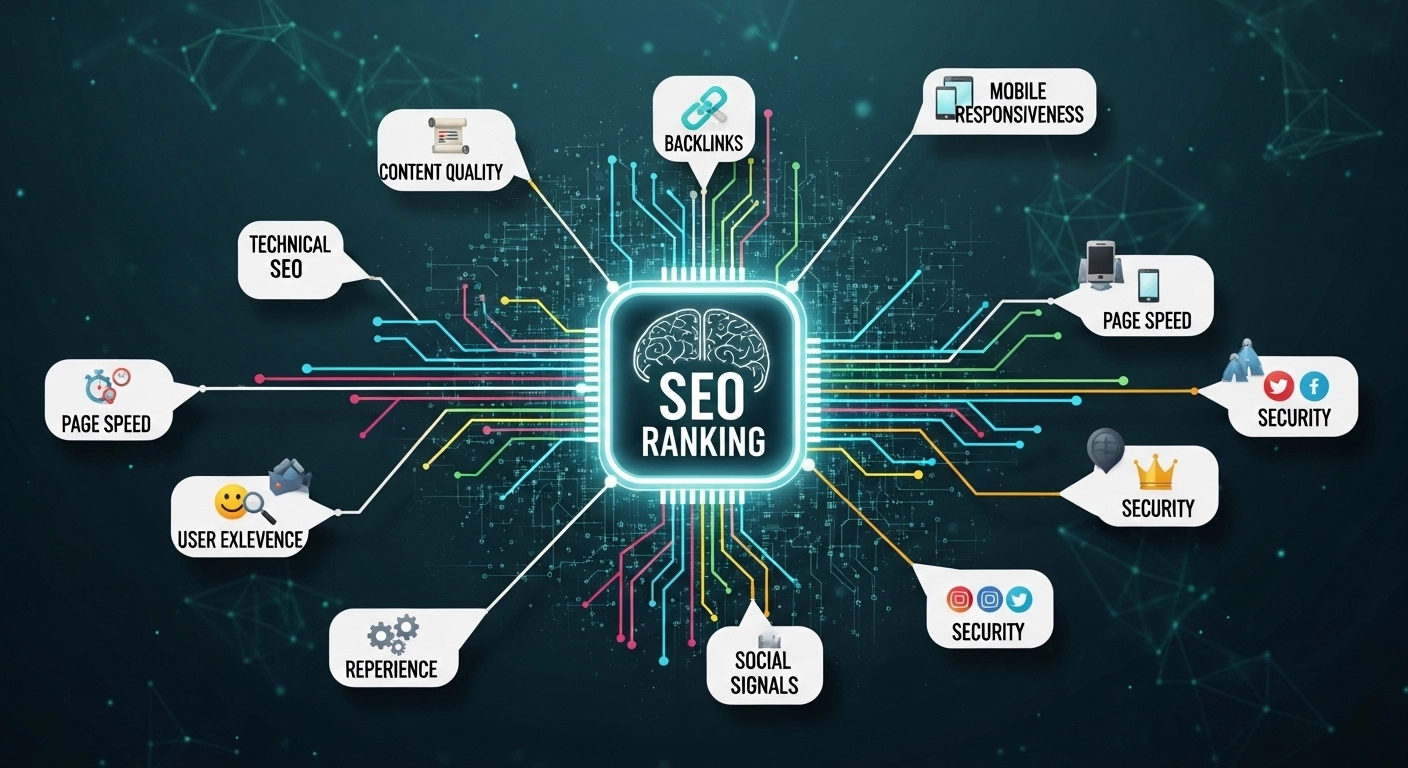
If you’ve ever wondered why one website ranks on page one of Google while another gets buried, the answer lies in SEO ranking signal factors. These are the clues search engines use to decide which pages deserve visibility, traffic, and trust.
But here’s the truth most people miss: Google doesn’t rely on a single factor. It evaluates hundreds of signals together to understand quality, relevance, and user satisfaction.
In this guide, we’ll break down the most important ranking signals in a simple, practical way so you can actually use them to improve your website.
What Are SEO Ranking Signal Factors?
SEO ranking signal factors are measurable elements that search engines use to evaluate and rank web pages.
Think of them like a scoring system. Every page gets evaluated based on:
- Relevance to search intent
- Content quality
- User experience
- Authority and trust
- Technical performance
The higher your score across these signals, the better your chances of ranking.
1. High-Quality Content (Still the #1 Signal)
Content remains the strongest ranking signal—but not just any content.
Google prefers content that is:
- Helpful and complete
- Written for humans, not algorithms
- Easy to understand
- Updated and accurate
Example:
A 2,000-word guide that answers all user questions will outperform a short, vague 300-word article—even if the shorter one is keyword-rich.
Key takeaway: Depth beats density.
2. Search Intent Alignment
Search engines are smarter than ever. They don’t just match keywords—they match intent.
There are 4 main types:
- Informational (learning something)
- Navigational (finding a site)
- Transactional (ready to buy)
- Commercial investigation (comparing options)
If your page doesn’t match what users actually want, it won’t rank—no matter how optimized it is.
Example:
If someone searches “SEO ranking signal factors,” they want a detailed explanation—not a product page or short definition.
3. Backlinks and Domain Authority
Backlinks are still one of the strongest SEO ranking signal factors.
But quality matters more than quantity.
Strong backlinks come from:
- Trusted websites
- Relevant niches
- Editorial mentions (not spammy directories)
Think of backlinks like votes:
A link from a respected site is a strong vote of confidence.
4. On-Page SEO Optimization
On-page SEO helps search engines understand your content clearly.
Important elements include:
- Title tags with clear keywords
- Meta descriptions that attract clicks
- Proper heading structure (H1, H2, H3)
- Internal linking
- Image alt text
But remember: optimization should feel natural, not forced.
5. Page Experience and User Behavior
Google tracks how users interact with your page. If people leave quickly, it signals low value.
Key user experience signals:
- Dwell time (how long users stay)
- Bounce rate
- Click-through rate (CTR)
- Scroll depth
A clean layout, fast loading, and readable content improve all of these.
6. Mobile-Friendliness
Most searches now happen on mobile devices, so Google prioritizes mobile-friendly pages.
Your site should:
- Load quickly on phones
- Be easy to navigate with thumbs
- Adjust properly to all screen sizes
If users struggle on mobile, rankings drop fast.
7. Page Speed and Core Web Vitals
Speed is not just a technical detail—it’s a ranking factor.
Core Web Vitals measure:
- Loading performance
- Interactivity
- Visual stability
Slow websites lose both rankings and users.
Even a 1-second delay can reduce conversions significantly.
8. Content Freshness
Google prefers updated content, especially for topics that change over time.
Fresh content signals:
- Updated statistics
- New examples
- Revised strategies
- Recent dates
Even small updates can improve rankings if they improve relevance.
9. Topical Authority
Instead of writing random articles, Google now favors websites that cover topics deeply.
This means:
- Multiple related articles on one subject
- Strong internal linking between them
- Consistent niche focus
For example, a site that publishes only SEO-related content will rank higher for SEO terms than a general blog.
10. Secure Website (HTTPS)
Security is a basic but essential ranking factor.
HTTPS:
- Protects user data
- Builds trust
- Improves credibility
If your site still uses HTTP, it’s at a disadvantage.
11. Structured Data (Schema Markup)
Schema helps search engines understand your content better.
It can improve:
- Rich snippets
- Click-through rates
- Search visibility
Examples include:
- FAQs
- Reviews
- Articles
- Products
12. Brand Signals
Google also looks at how people interact with your brand online.
Stronger brand signals include:
- Branded searches (people searching your name)
- Mentions on other websites
- Social presence
- Consistent reputation
A strong brand often outranks weaker competitors—even with similar SEO.
FAQ: SEO Ranking Signal Factors
What are the most important SEO ranking signals?
The top signals are high-quality content, backlinks, search intent alignment, and user experience.
How many ranking factors does Google use?
Google uses hundreds of signals, but only a handful have major impact on rankings.
Are backlinks still important in 2026?
Yes, but quality matters more than quantity. Relevant, trusted links are most valuable.
Can good content rank without backlinks?
Yes, but it’s harder in competitive niches. Backlinks still boost authority and speed up rankings.
How long does SEO take to show results?
Typically 3–6 months depending on competition, content quality, and website authority.
Conclusion
SEO ranking signal factors are not about tricks or shortcuts—they’re about building a website that genuinely deserves to rank.
If you focus on:
- Useful content
- Strong user experience
- Relevant backlinks
- Technical performance
- Search intent alignment
You’re already ahead of most websites trying to rank.
