
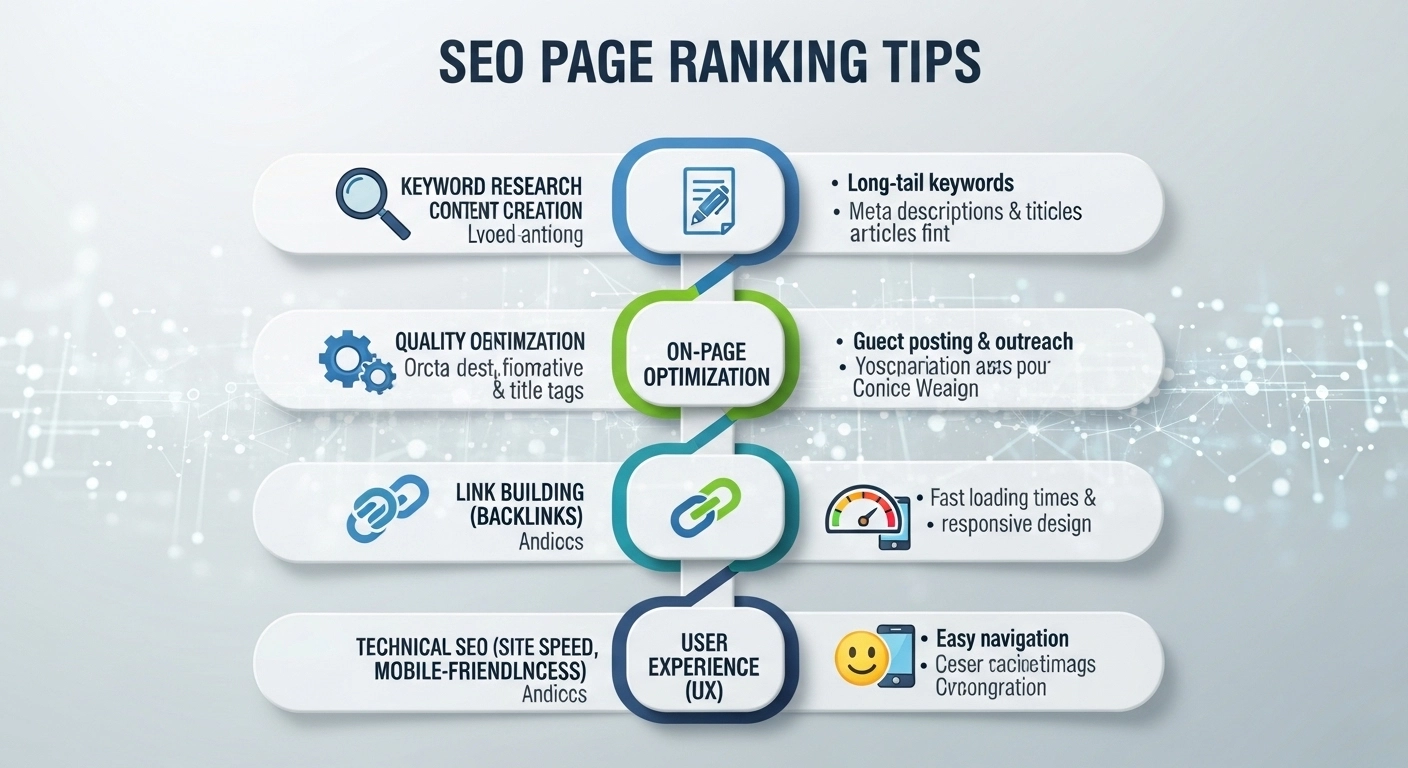
Getting your website to rank on the first page of Google is still one of the most powerful ways to grow organic traffic. But SEO today is not about shortcuts—it’s about relevance, user experience, and smart optimization.
If you’re looking for practical, no-fluff SEO page ranking tips, this guide breaks everything down in a way that’s simple, actionable, and aligned with how search engines actually work today.
1. Start With Search Intent (Not Just Keywords)
Before you write a single line of content, understand what the user actually wants.
Google’s goal is simple: show the most useful result for every search.
There are four main types of search intent:
- Informational: “how SEO works”
- Navigational: “Ahrefs blog”
- Transactional: “buy SEO tools”
- Commercial investigation: “best SEO tools for beginners”
If your content doesn’t match intent, it won’t rank—no matter how well optimized it is.
Example:
If someone searches “SEO page ranking tips,” they don’t want theory. They want practical steps they can apply immediately. That’s exactly what Google rewards.
2. Create High-Quality, Helpful Content
Content quality is still one of the strongest ranking factors.
But “high-quality” doesn’t mean long—it means useful.
A strong SEO page should:
- Answer the user’s question clearly
- Be easy to scan and understand
- Include real examples or steps
- Avoid unnecessary filler
Think of your content as a solution, not an article.
Tip: If a reader can solve their problem without searching again, your content is doing its job.
3. Optimize Title Tags and Meta Descriptions
Your title is often the first impression in search results.
A good SEO title should:
- Include your main keyword naturally
- Be clear and specific
- Encourage clicks without clickbait
Example:
Instead of:
“SEO Tips for Websites”
Use:
“SEO Page Ranking Tips: How to Improve Your Google Rankings Fast”
Your meta description should support the title and explain the benefit in one or two sentences.
4. Use Proper Heading Structure (H1, H2, H3)
Search engines use headings to understand your content structure.
A clean structure improves both SEO and readability:
- H1 → Main title (only one per page)
- H2 → Main sections
- H3 → Sub-points inside sections
This helps Google understand topic hierarchy and improves user experience.
5. Improve Page Speed and Mobile Experience
Google prioritizes fast and mobile-friendly websites.
If your page loads slowly, users leave—and rankings drop.
Focus on:
- Compressing images
- Using lightweight themes
- Reducing unnecessary scripts
- Enabling caching
Also ensure your site works smoothly on mobile devices, since most searches now happen on phones.
6. Use Internal Linking Strategically
Internal links help Google discover and understand your content structure.
They also keep users on your site longer.
Best practices:
- Link related pages naturally
- Use descriptive anchor text
- Don’t overdo it—keep it relevant
Example:
If you mention keyword research, link to a page that explains keyword research in detail.
7. Earn High-Quality Backlinks
Backlinks are still one of the strongest ranking signals.
But quality matters more than quantity.
Focus on:
- Guest posting on relevant sites
- Creating shareable content (guides, stats, tools)
- Digital PR and outreach
- Building relationships in your niche
Avoid spammy or low-quality links—they can hurt rankings instead of helping.
8. Optimize for User Experience (UX)
Google tracks how users interact with your page.
If people stay longer, click around, and don’t bounce quickly, your page is seen as valuable.
Improve UX by:
- Using short paragraphs
- Adding bullet points where needed
- Making content easy to scan
- Avoiding intrusive ads or popups
A clean, readable page often outranks a messy one—even if the content is similar.
9. Add Semantic Keywords Naturally
Modern SEO is not just about repeating a keyword.
Google understands context and related terms.
For “SEO page ranking tips,” include natural variations like:
- Google ranking factors
- On-page SEO
- Search engine optimization strategies
- Organic traffic growth
- SERP visibility
This helps your content appear more relevant without keyword stuffing.
10. Keep Content Updated Regularly
SEO is not a one-time task.
Google prefers fresh, updated content—especially in competitive niches.
Update your pages when:
- New ranking factors appear
- Tools or strategies change
- Your content becomes outdated
Even small updates can help maintain or improve rankings over time.
FAQs: SEO Page Ranking Tips
How long does it take to rank a page on Google?
It usually takes anywhere from a few weeks to several months, depending on competition, domain authority, and content quality.
Do keywords still matter for SEO?
Yes, but context matters more than exact match repetition. Focus on natural usage and related terms.
What is the most important ranking factor?
There is no single factor, but high-quality content combined with strong user experience and backlinks has the biggest impact.
Can new websites rank quickly?
Yes, but only if they target low-competition keywords and publish highly useful content consistently.
Conclusion
Improving your rankings is not about tricking Google—it’s about building pages that genuinely help users.
If you focus on search intent, content quality, technical SEO, and user experience, your pages will naturally climb the search results over time.
