
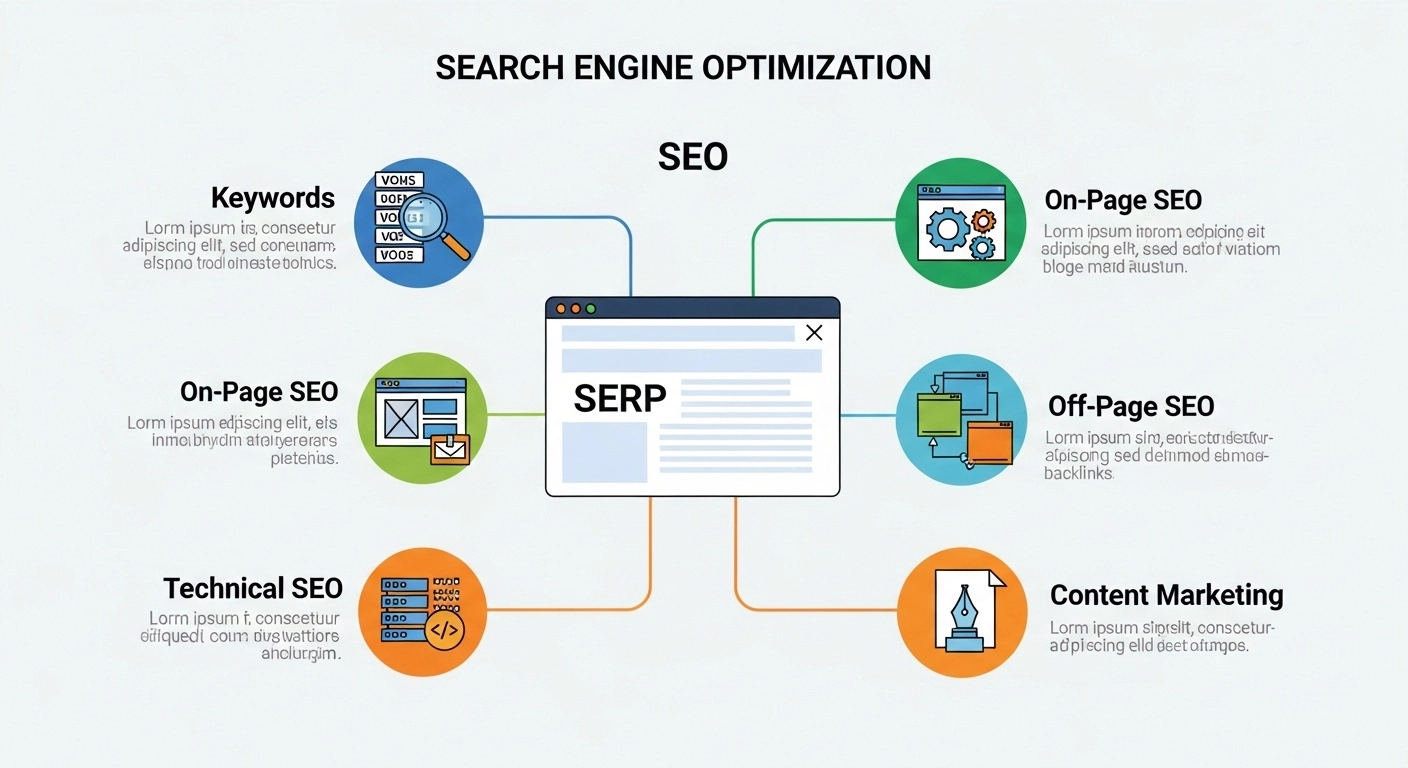
If you want your website to appear on the first page of Google, understanding SEO basics is essential. Search Engine Optimization (SEO) is the process of improving your website so that search engines can easily find, understand, and rank your content.
Every day, billions of searches happen online. Businesses that master SEO gain higher visibility, more organic traffic, and better opportunities for lead generation and online growth.
However, many beginners feel overwhelmed by SEO because search engines constantly update their algorithms. The truth is that most successful websites follow the same fundamental principles.
Learning the SEO basics for beginners helps you:
- Improve website rankings
- Increase organic traffic
- Build website authority
- Attract targeted customers
- Grow your online presence
This comprehensive guide explains the fundamentals of SEO, including keyword research, on-page optimization, technical SEO, and link building. By the end, you will understand how search engines work and how to optimize your website for long-term success.
What Is SEO and Why It Matters
Search Engine Optimization is the practice of improving your website’s visibility in organic search results on search engines like Google.
When users search for information, products, or services, search engines show the most relevant and trustworthy pages.
Websites that follow strong SEO practices are more likely to appear higher in search results.
How Search Engines Work
Search engines operate through three main processes:
Crawling
Search engines use bots (called crawlers or spiders) to discover pages on the internet.
They follow links across websites to find new content.
Indexing
After discovering pages, search engines store and organize them in a massive database called the index.
Ranking
When someone performs a search, Google’s algorithm analyzes hundreds of factors to determine which pages should appear first.
These factors include:
- Content quality
- Relevance
- Page speed
- Backlinks
- User experience
Understanding these fundamentals is the first step in mastering SEO basics.
Keyword Research: The Foundation of SEO
Keyword research is the process of discovering the search terms people use when looking for information online.
Targeting the right keywords helps search engines understand what your content is about.
Types of SEO Keywords
Different types of keywords serve different purposes.
Short-Tail Keywords
Short-tail keywords are broad search terms.
Example:
- SEO
- Digital marketing
They usually have high search volume but strong competition.
Long-Tail Keywords
Long-tail keywords are longer, more specific search queries.
Examples:
- SEO basics for beginners
- How to learn SEO step by step
- Best SEO tips for small businesses
These keywords usually have lower competition and higher conversion rates.
Informational Keywords
These keywords target users looking for knowledge.
Examples:
- What is SEO
- How does SEO work
Commercial Keywords
These indicate buying intent.
Examples:
- Best SEO services
- SEO tools for business
Step-by-Step Keyword Research Process
Step 1: Identify Your Main Topic
Start with a broad topic related to your business.
Example: SEO basics.
Step 2: Use Keyword Research Tools
Popular tools include:
- Google Keyword Planner
- Ubersuggest
- Ahrefs
- SEMrush
Step 3: Analyze Search Intent
Determine what users expect when searching for a keyword.
Search intent types include:
- Informational
- Navigational
- Commercial
- Transactional
Step 4: Choose Target Keywords
Select keywords that have:
- Good search volume
- Manageable competition
- Clear relevance to your content
On-Page SEO Basics
On-page SEO refers to optimizing the elements within your website pages to improve rankings.
Important On-Page SEO Factors
Title Tags
Title tags are one of the most important ranking factors.
They appear as the clickable headline in search results.
Best practices:
- Include the target keyword
- Keep length between 50–60 characters
- Make it compelling for clicks
Meta Descriptions
Meta descriptions summarize your page content.
Although not a direct ranking factor, they improve click-through rates.
Best practices:
- Include primary keywords
- Keep under 160 characters
- Write persuasive descriptions
Header Tags (H1, H2, H3)
Headers organize your content for readers and search engines.
Structure example:
- H1: Main topic
- H2: Major sections
- H3: Supporting points
URL Structure
SEO-friendly URLs should be short and descriptive.
Example:
Good:
example.com/seo-basics
Bad:
example.com/page?id=123
Internal Linking
Internal links connect pages within your website.
Benefits include:
- Improved site navigation
- Better crawling
- Increased page authority
Technical SEO Fundamentals
Technical SEO focuses on optimizing your website’s infrastructure so search engines can crawl and index it efficiently.
Core Technical SEO Elements
Website Speed
Fast websites improve both rankings and user experience.
Ways to improve speed:
- Optimize images
- Use caching
- Reduce unnecessary scripts
Mobile Optimization
Google uses mobile-first indexing, meaning your mobile site is the primary version used for ranking.
Ensure your website is:
- Mobile-friendly
- Responsive
- Easy to navigate
XML Sitemap
A sitemap helps search engines discover important pages on your site.
Submit it to Google Search Console.
Secure Website (HTTPS)
Security is a ranking factor.
Ensure your website uses an SSL certificate.
Technical SEO Checklist
Step-by-Step Optimization
- Check website speed using PageSpeed Insights
- Fix crawl errors in Google Search Console
- Optimize mobile responsiveness
- Submit XML sitemap
- Ensure HTTPS security
Content Optimization for SEO
High-quality content is the backbone of successful SEO.
Search engines prioritize content that is helpful, relevant, and authoritative.
Key Elements of SEO Content
Search Intent Alignment
Content must match what users expect when they search.
Example:
If someone searches “SEO basics,” they expect a beginner-friendly guide.
Semantic SEO
Semantic SEO involves including related terms that help search engines understand context.
Examples related to SEO basics:
- search engine ranking
- organic traffic
- keyword optimization
- website authority
Content Depth
Comprehensive content tends to rank higher.
Cover the topic fully rather than writing shallow content.
Content Optimization Framework
Step 1: Research Competitors
Analyze top-ranking pages.
Step 2: Identify Content Gaps
Look for questions competitors didn’t answer.
Step 3: Add Unique Value
Provide:
- Examples
- Case studies
- Step-by-step guides
Link Building: Building Website Authority
Backlinks are links from other websites pointing to your site.
They are one of the most important ranking factors in Google’s algorithm.
Why Backlinks Matter
Backlinks act as votes of confidence.
Websites with more high-quality backlinks tend to rank higher.
Effective Link Building Strategies
Guest Blogging
Write articles for other websites and include a link to your site.
Content Marketing
Create valuable content that naturally attracts links.
Digital PR
Earn backlinks through media mentions and press coverage.
Broken Link Building
Find broken links on websites and suggest your content as a replacement.
Local SEO Basics for Businesses
Local SEO helps businesses appear in location-based search results.
Example searches:
- SEO agency near me
- Digital marketing services in Lahore
Key Local SEO Factors
- Google Business Profile optimization
- Local citations
- Customer reviews
- Location-based keywords
Local SEO Optimization Steps
- Create a Google Business Profile
- Add accurate business information
- Collect customer reviews
- Use local keywords in content
Future of SEO: AI, Voice Search, and Algorithm Updates
Search engines are evolving rapidly with artificial intelligence and machine learning.
Understanding future trends helps you stay ahead.
AI-Powered Search
Search engines now analyze content using AI models to understand context and intent.
This makes high-quality, expert content more important than ever.
Voice Search Optimization
Voice searches are increasing due to smart assistants.
Examples:
- “What are SEO basics?”
- “How do I improve my website ranking?”
Optimize content using conversational phrases and natural language.
E-E-A-T Principles
Google evaluates content based on:
- Experience
- Expertise
- Authority
- Trust
Websites that demonstrate these qualities tend to rank higher.
FAQ: SEO Basics
What are SEO basics?
SEO basics refer to fundamental strategies used to improve a website’s visibility in search engines, including keyword research, on-page optimization, technical SEO, and link building.
How long does SEO take to work?
SEO is a long-term strategy. Most websites begin seeing noticeable improvements within 3 to 6 months, depending on competition and optimization efforts.
Is SEO free or paid?
SEO itself is free because it focuses on organic search results. However, businesses often invest in SEO tools, content creation, or professional SEO services.
What is the most important SEO factor?
High-quality content that matches user search intent is one of the most important ranking factors.
Can beginners learn SEO?
Yes. Anyone can learn SEO basics by understanding how search engines work and applying optimization techniques consistently.
How do keywords help SEO?
Keywords help search engines understand what your content is about and match it with relevant user searches.
Conclusion
Mastering SEO basics is the first step toward building a successful online presence.
By understanding how search engines work and implementing proven strategies, you can significantly improve your website’s visibility.
The most important SEO principles include:
- Conducting proper keyword research
- Optimizing on-page SEO elements
- Improving technical website performance
- Creating high-quality content
- Building strong backlinks
SEO is not a one-time task—it is an ongoing process.
Businesses that invest in SEO consistently gain higher rankings, increased traffic, and long-term digital growth.
Start applying these SEO basics today, and your website will be well positioned to compete in search results now and in the future. 🚀
