
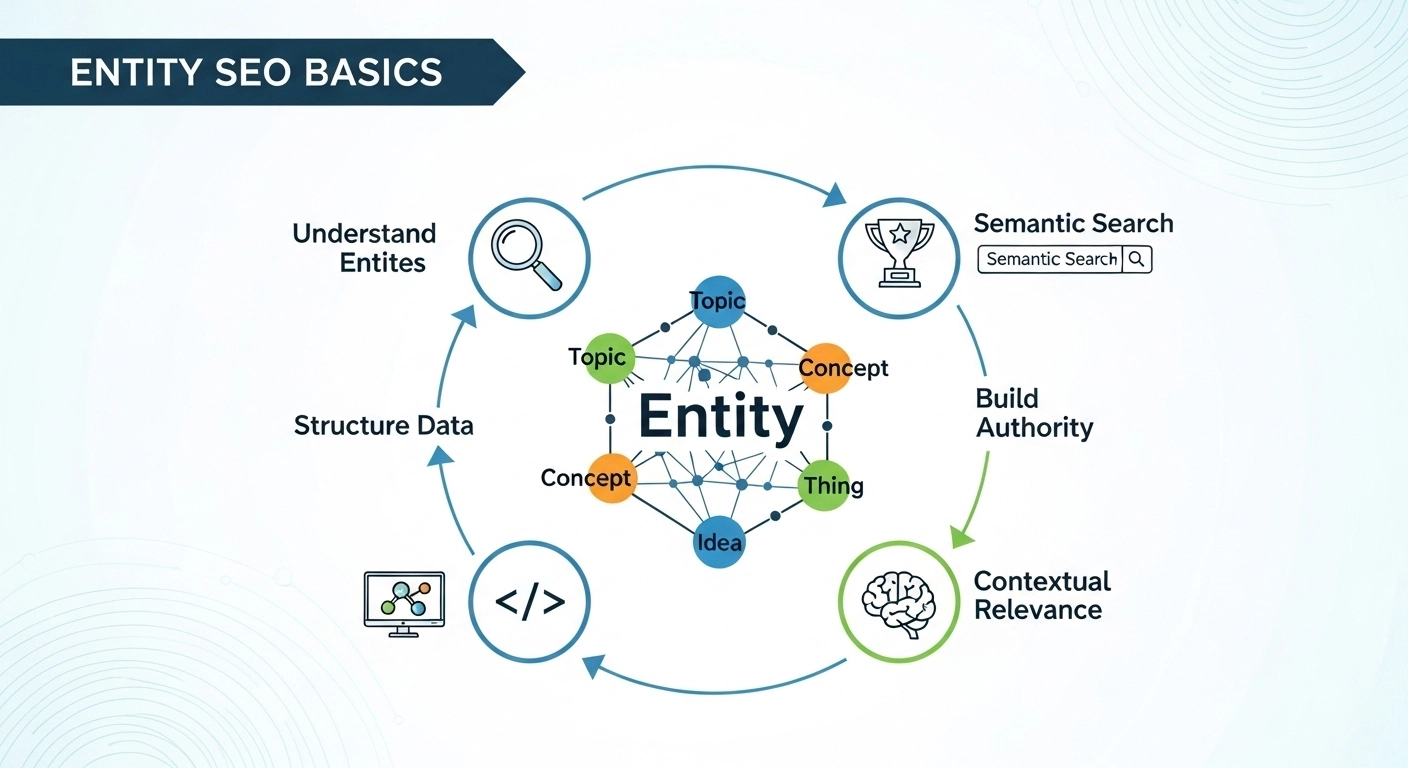
If you want your content to rank consistently in modern search results, learning Entity SEO is essential. This guide explains what entity SEO is, why it matters, and how you can use it to improve your rankings.
What Is Entity SEO?
Entity SEO is the practice of optimizing content around entities instead of just keywords.
An entity is a clearly identifiable thing—such as a person, place, organization, or concept—that search engines understand independently of specific wording.
Examples of entities include:
- Companies (Google, Apple, Microsoft)
- People (Elon Musk, Taylor Swift)
- Places (New York City, Mount Everest)
- Concepts (Digital Marketing, Machine Learning)
Search engines store these entities in massive databases called knowledge graphs, which help them understand relationships between topics.
For example, when you search “Tesla founder”, Google understands that the entity Elon Musk is strongly connected to Tesla.
That’s the power of entity-based search.
Why Entity SEO Matters Today
Search engines are no longer matching pages purely based on keywords. Instead, they analyze context, meaning, and relationships between entities.
Here’s why entity SEO matters:
1. Google Understands Context Better
Google’s algorithms like RankBrain, BERT, and MUM interpret search queries semantically. This means they focus on meaning, not just exact words.
2. It Improves Topical Authority
When your content connects related entities, search engines see your site as a trusted authority on the topic.
3. It Helps You Rank for More Keywords
Instead of targeting one keyword, entity-based content ranks for dozens or even hundreds of related searches.
4. It Supports Featured Snippets and Knowledge Panels
Structured entity signals increase your chances of appearing in:
- Featured snippets
- Knowledge panels
- People Also Ask results
Keywords vs Entity SEO
| Traditional SEO | Entity SEO |
| Focus on exact keywords | Focus on topic understanding |
| One keyword per page | Multiple related entities |
| Keyword density matters | Context and relationships matter |
| Easier to manipulate | Harder but more powerful |
Keywords still matter—but entities add depth and meaning.
How Search Engines Identify Entities
Search engines recognize entities using several signals.
Knowledge Graphs
Google’s Knowledge Graph stores billions of entities and their relationships.
For example:
- Entity: Barack Obama
- Related entities: United States, President, Michelle Obama, White House
Structured Data
Structured data (schema markup) helps search engines understand entities clearly.
Examples:
- Person schema
- Organization schema
- Product schema
- Article schema
Contextual Content
Search engines also analyze surrounding words to identify entities.
Example:
If an article mentions:
- iPhone
- Apple
- Tim Cook
- iOS
Google easily understands the main entity is Apple Inc.
How to Optimize Content for Entity SEO
Here are practical steps you can use today.
1. Focus on Topics, Not Just Keywords
Instead of writing for a single keyword, cover the entire topic.
Example:
Keyword approach
“Best running shoes”
Entity approach
Include related entities such as:
- Nike
- Adidas
- Marathon running
- Foot support
- Cushion technology
This builds semantic depth.
2. Use Natural Language and Related Terms
Search engines expect natural language.
Instead of repeating the same keyword, include semantic variations such as:
- related concepts
- synonyms
- subtopics
- supporting entities
This improves topical relevance.
3. Create Content Hubs
Entity SEO works best with topic clusters.
Example:
Main topic: Digital Marketing
Supporting articles:
- SEO basics
- Content marketing
- Email marketing
- Social media marketing
All pages internally link to reinforce the entity relationship.
4. Add Schema Markup
Structured data helps search engines clearly identify entities on your page.
Common schema types:
- Article
- FAQ
- Product
- Organization
- LocalBusiness
This improves search visibility and rich results.
5. Build Author Authority
Google also evaluates author entities.
Make sure your content includes:
- Author name
- Author bio
- Social profiles
- Expertise signals
This supports E-E-A-T (Experience, Expertise, Authority, Trust).
6. Use Internal Linking Strategically
Internal links help search engines connect entities across your site.
Example:
An article about content marketing should link to:
- SEO strategy
- keyword research
- link building
This strengthens topic relationships.
Simple Example of Entity SEO
Let’s say you’re writing about coffee.
Weak keyword-only content might include:
- best coffee beans
- coffee brewing tips
Entity-focused content would include:
- Arabica coffee
- Espresso
- Coffee grinder
- Starbucks
- French press
- Caffeine
Now search engines understand the entire ecosystem of the topic.
FAQ: Entity SEO Basics
What is an entity in SEO?
An entity is a unique, identifiable thing—such as a person, place, brand, or concept—that search engines understand independently of keywords.
Is Entity SEO replacing keyword SEO?
No. Keywords still matter, but modern SEO combines keywords with entity-based optimization to provide better context.
How do I find entities for my content?
You can identify entities by:
- Checking Google’s “People Also Ask”
- Reviewing top-ranking pages
- Using SEO tools that show semantic keywords
Does schema markup improve entity SEO?
Yes. Structured data helps search engines clearly recognize entities on a webpage and connect them to knowledge graphs.
Is Entity SEO important for beginners?
Absolutely. Even basic entity optimization—like covering related topics and linking relevant content—can significantly improve rankings.
Final Thoughts
SEO has moved far beyond simple keyword matching. Search engines now focus on understanding topics, relationships, and real-world entities.
By structuring your content around entities, context, and semantic relevance, you create pages that search engines trust and users actually find useful.
The result?
- Better rankings
- More organic traffic
- Stronger topical authority
